Item number: 60223
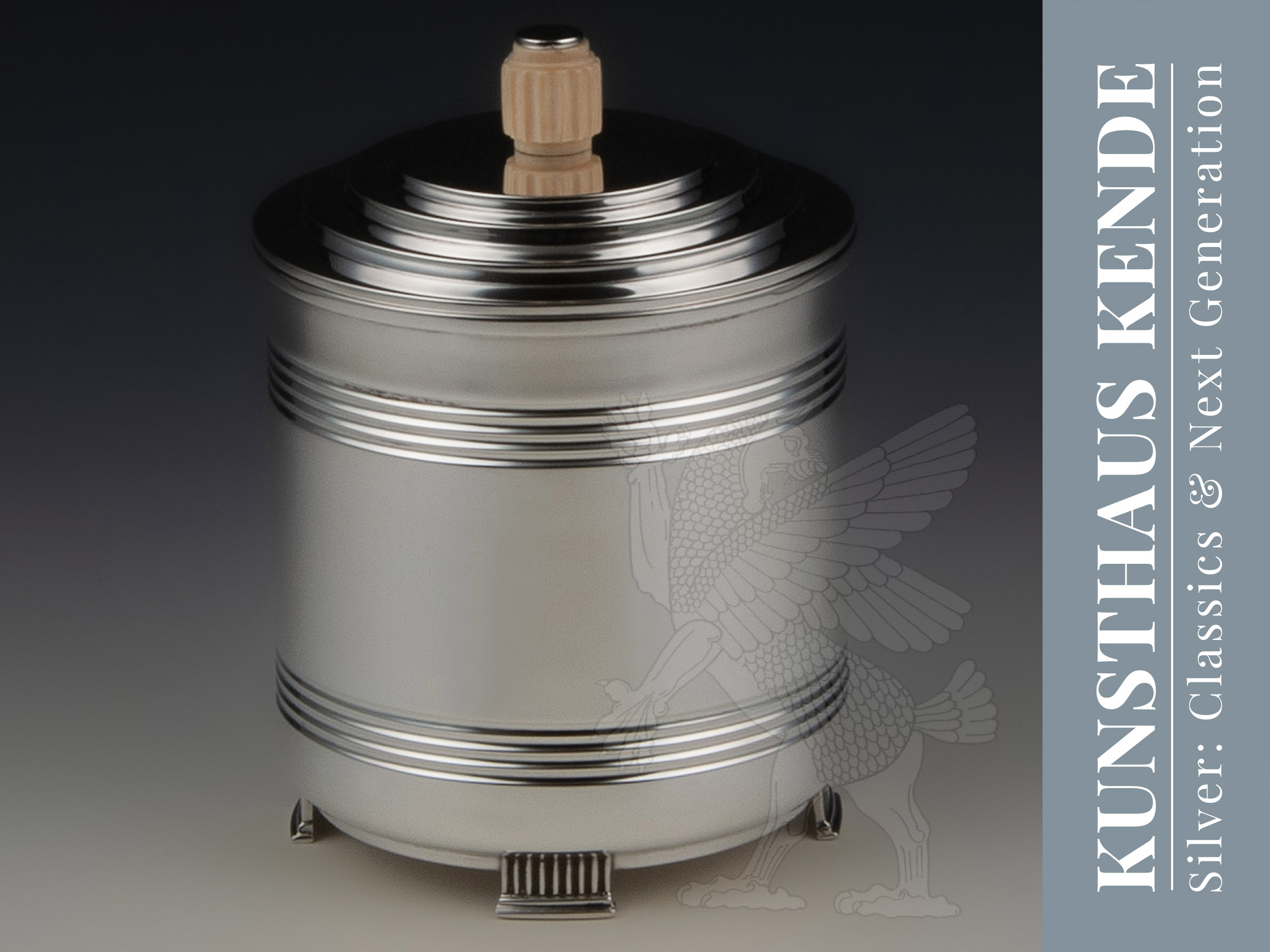
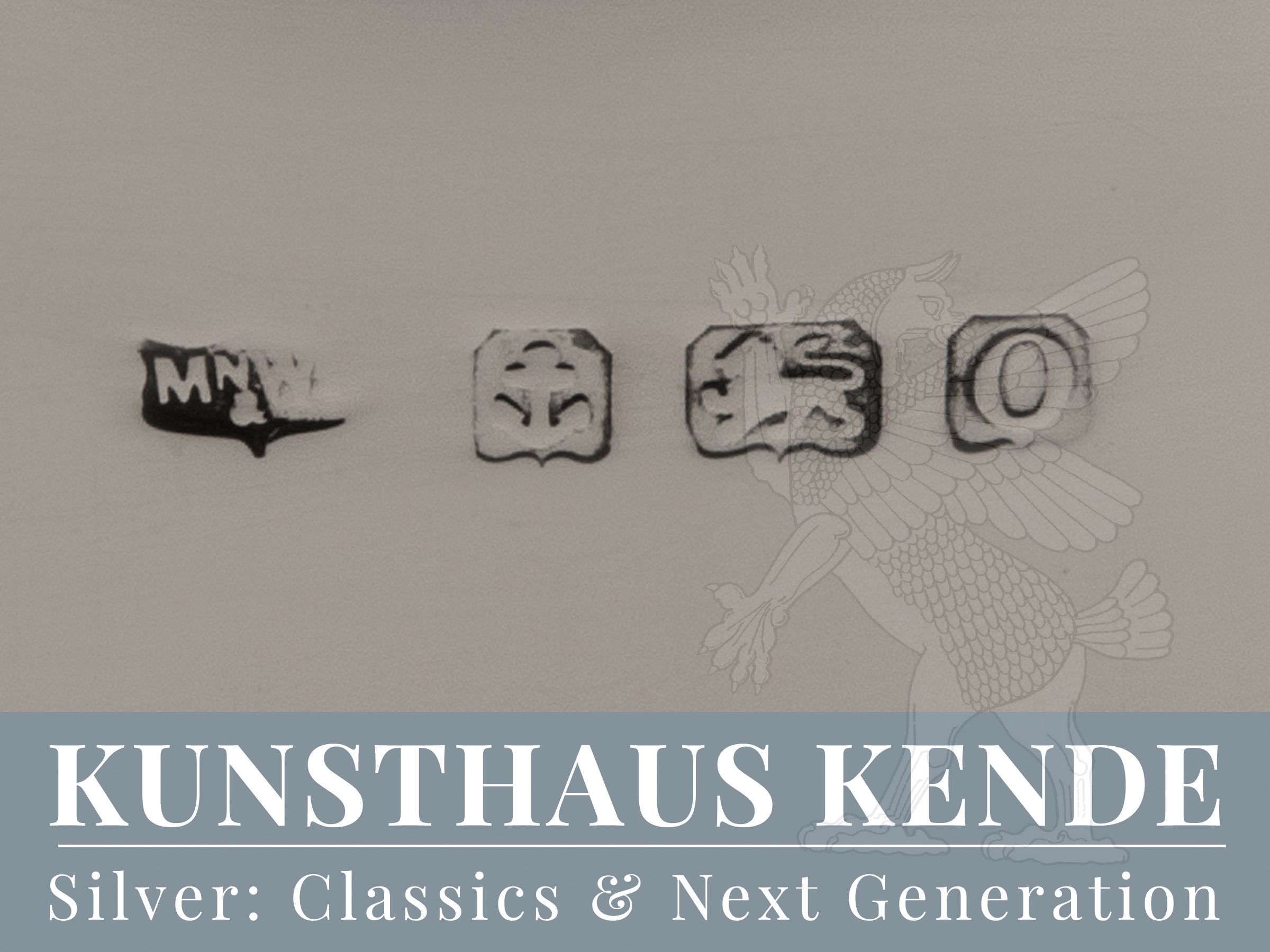
An Art Déco sterling silver biscuit barrel, Birmingham 1938,
designed by Keith Murray for Mappin & Webb
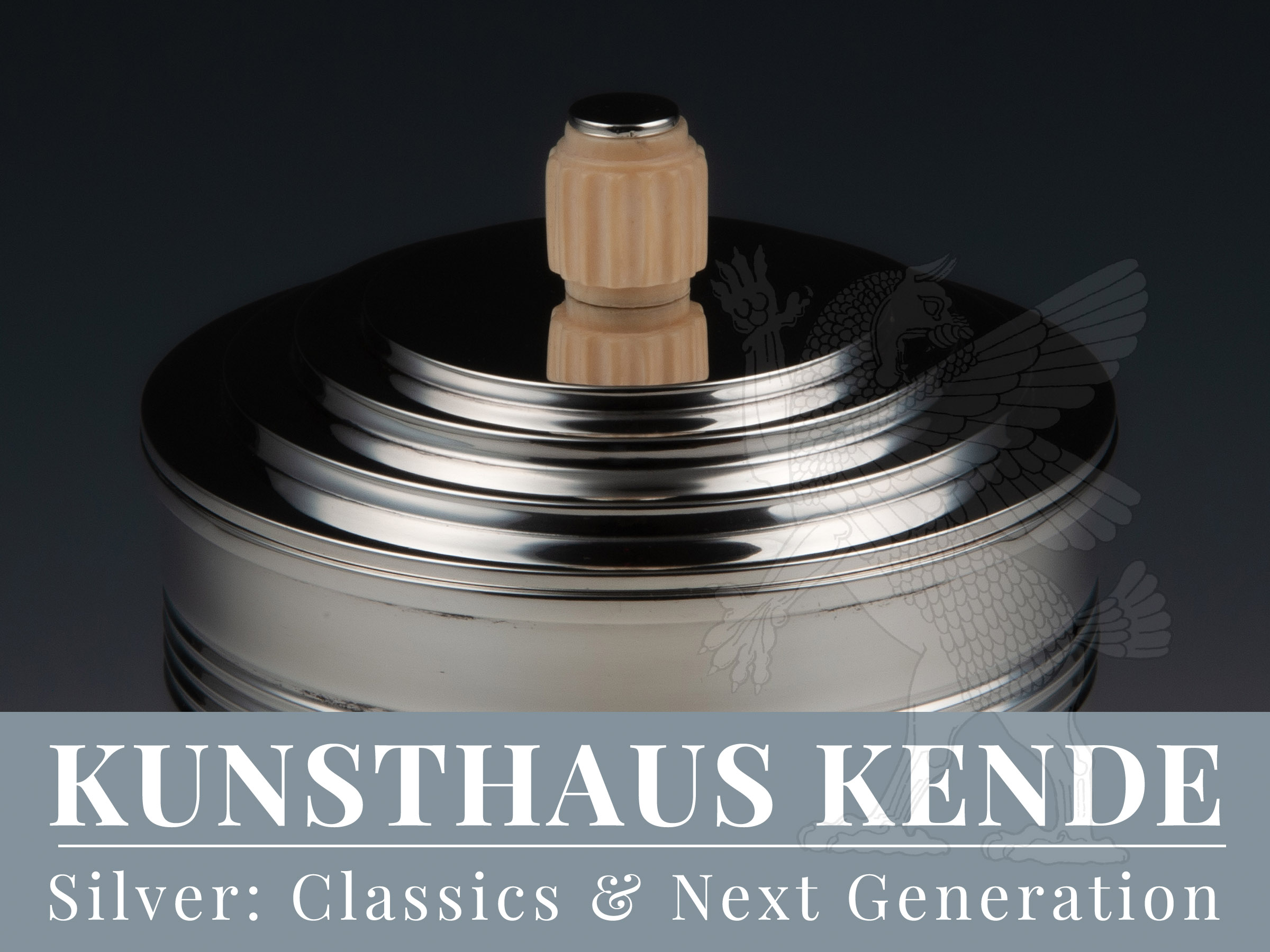
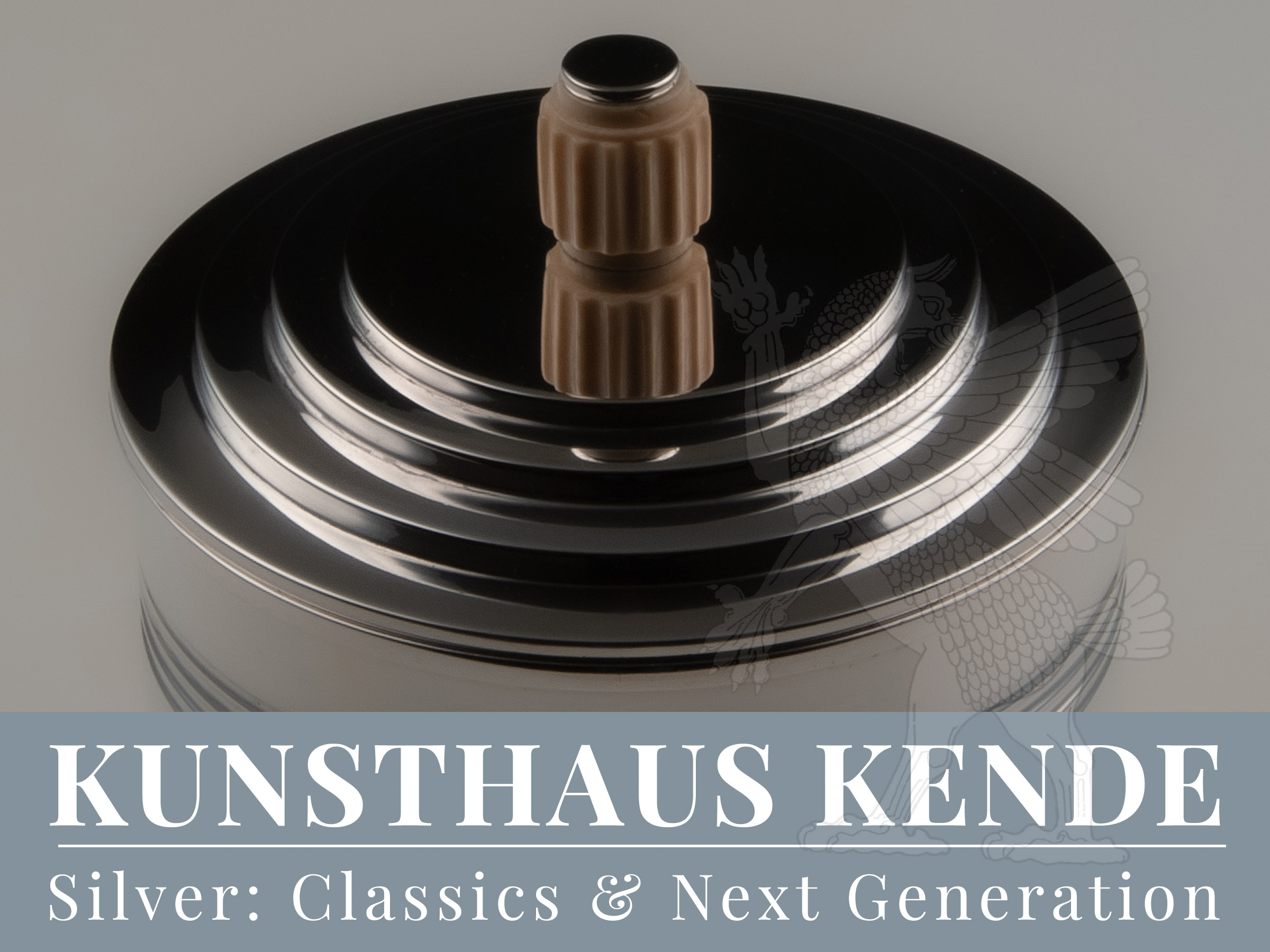
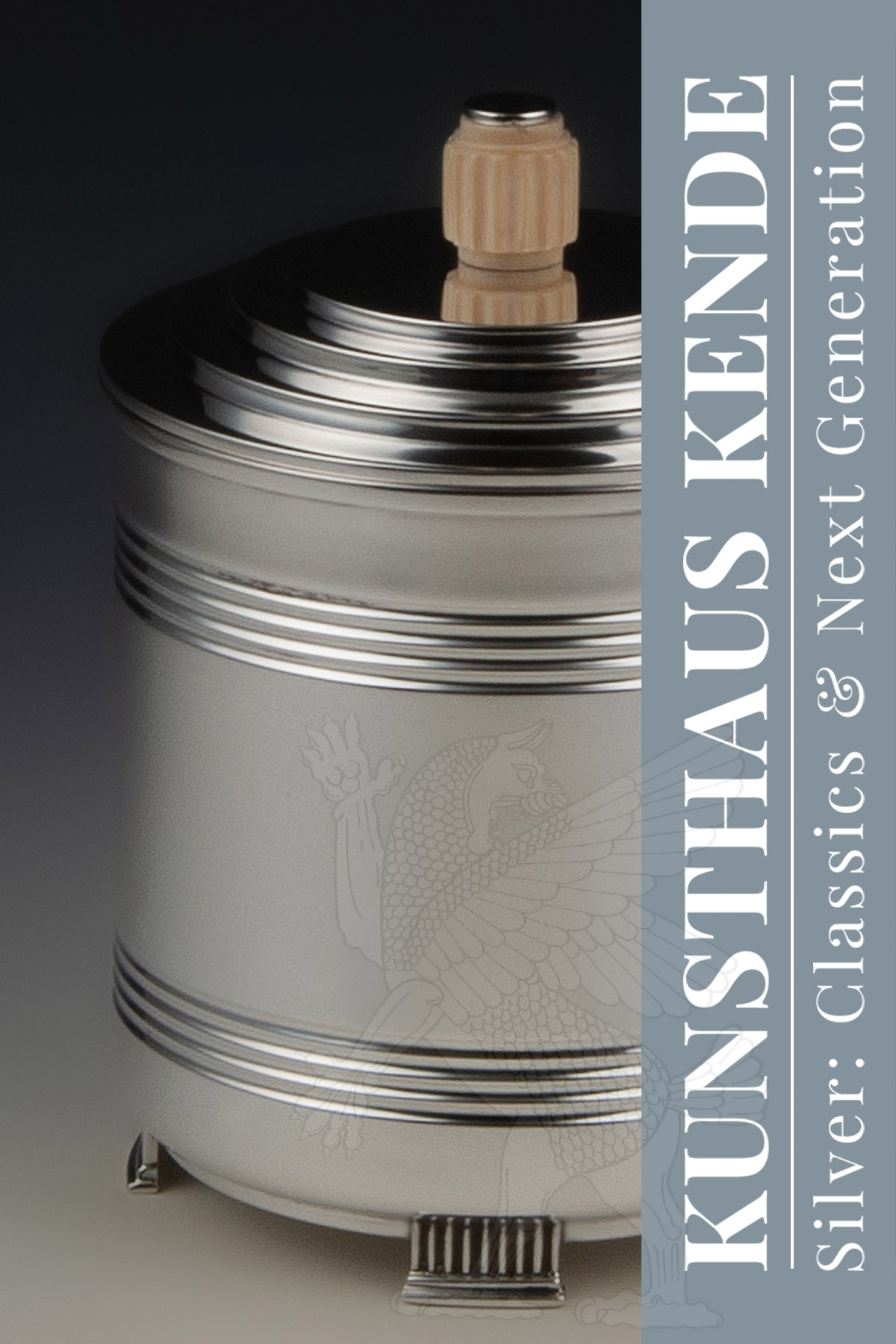
The cylindrical body resting on four bracket feet, divided by two bands of decoration. The removable stepped lid topped with an ivory knob which is adorned with horizontal ribs.
A rare and beautifully shaped Art Deco sterling silver biscuit barrel in excellent, undamaged condition.
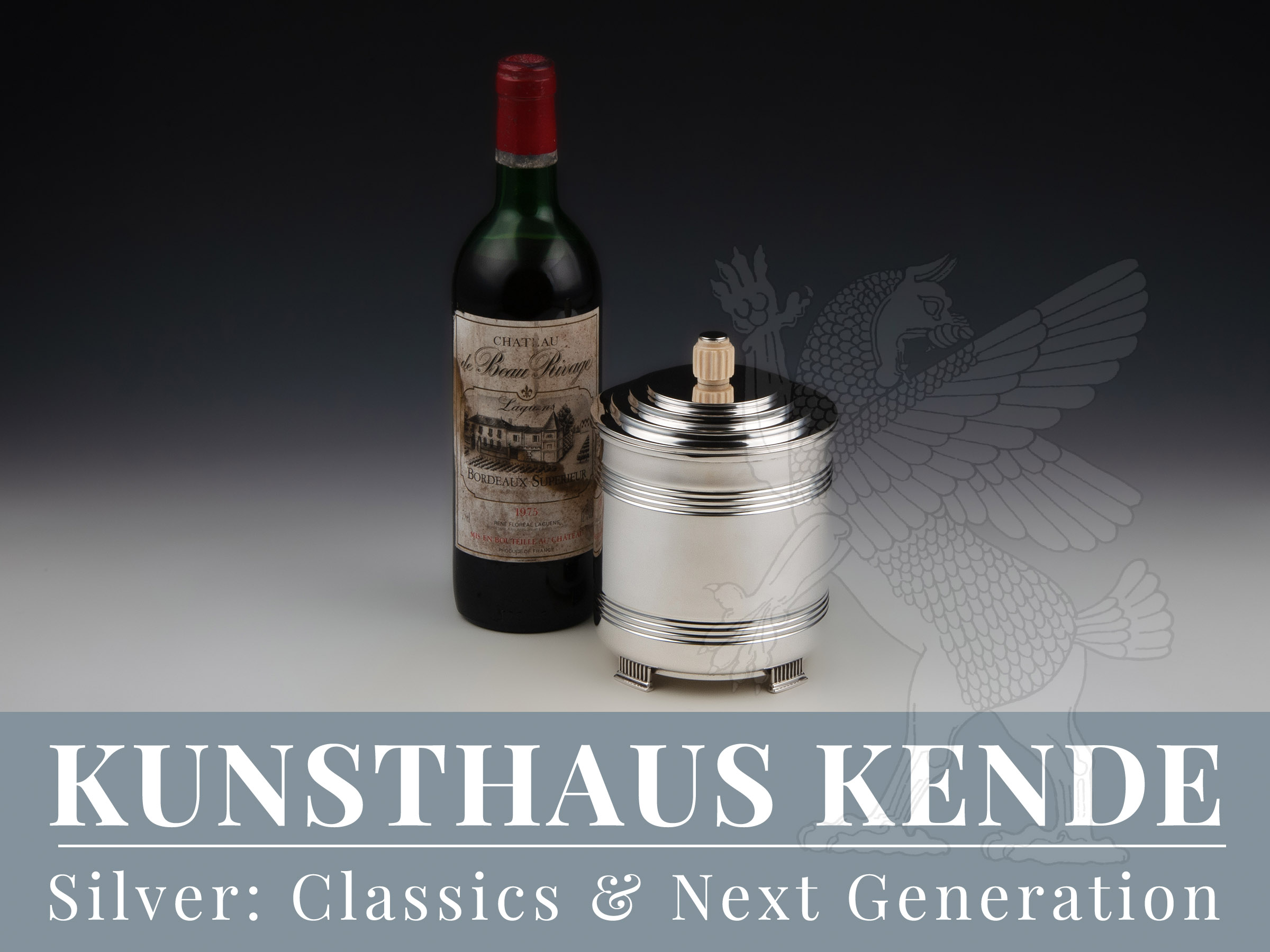
16.7 cm / 6.57″ tall (to the knob), 12.2 cm / 4.8″ diameter; 469.7 g / 15.10 oz
The British architect and industrial designer Keith Murray (1892–1981)
Keith Day Pearce Murray achieved great renown in Britain as an architect and designer of industrial art. In addition to his architectural designs, his work in silver, ceramics and glass became seminal for British decorative arts in the Art Deco and early Modernist periods. Keith Murray was born in Mount Eden, Auckland, New Zealand, and moved to Britain with his family as a teenager in 1906, where he began studying architecture in London. His professional career was interrupted by the events of the First World War, during which he served as an officer in the Royal Flying Corps and the Royal Air Force, being awarded the Military Cross for his bravery. After the war ended, he completed his architectural training and became a member of the Royal Institute of British Architects in 1921. The economic downturn of the late 1920s and early 1930s prevented him from securing major projects in his work as an architect, which forced Murray to turn his attention to industrial design, a field in which he would go on to achieve success in the years that followed.
Inspired by the 1925 Paris World’s Fair and the 1931 exhibition of Swedish industrial art, Murray sought to collaborate with leading manufacturers of mass-produced household goods. After initial difficulties in gaining acceptance from buyers, he began creating designs for Stevens & Williams in 1932, whose glassware became known as the ‘Keith Murray Range’. These pieces displayed the clean architectural lines and refined geometric forms that were to become his trademark. However, the more than 1,200 designs he conceived between 1932 and 1939 were produced only in small batches. In 1932, Keith Murray was recruited by Josiah Wedgwood in Etruria to work as a designer for the ceramics factory. There, Keith Murray designed some of the company’s best-known Art Deco forms, including the famous ribbed ‘Annular’ product line. His high standing as a designer was reflected in the privilege that his signature was affixed above the Wedgwood logo on every piece produced. This privilege underscored his social standing as a designer of national stature. Keith Murray received a further boost to his reputation in 1934 when the silverware firm Mappin & Webb commissioned him to design modern silverware. This biscuit tin impressively demonstrates his artistic ability to conceive objects of great clarity and modernity, which remain surprisingly contemporary even today. For cost reasons, however, many of his designs were produced in silver-plated metal.
His characteristic design language set the trend for the arts and crafts movement in Britain. Keith Murray’s oeuvre was characterised by clear, minimalist linear ornamentation in the form of sculptural bands and stepped profiles, which decoratively subdivided the otherwise unadorned surface. After the Second World War, Keith Murray appears to have worked exclusively as an architect, where he also left a significant legacy in the field of industrial design.
The Mappin & Webb silversmithy
Founded in 1775 by Jonathan Mappin as a workshop for silver cutlery in Sheffield, the silversmithy soon made a name for itself with its high-quality cutlery. In 1780, Jonathan Mappin was granted citizenship by the Cutlers’ Company. The business was continued by Jonathan Mappin’s son Joseph and later by his grandson, who was also named Joseph.
However, the greatest expansion took place in the mid-19th century, when Jonathan’s four great-grandsons renamed the company Mappin Brothers Ltd. The company expanded internationally, received privileges from the English court, and was soon followed by commissions from various royal houses in Europe as well as beyond Europe for the production of silverware. Despite the great success, three of the managing brothers withdrew and founded their own companies. The business continued under John Mappin. A few years later, John Mappin joined forces with his brother-in-law George Webb to form the silversmithy Mappin & Webb, which is still well-known today.