Item number: 60243
Exceptional Vase in Shidō 洋陽 (Yōyō) – Sun Over the Sea,
Violet copper, Tōkyō 2024,
by Yasuyoshi Matsumoto
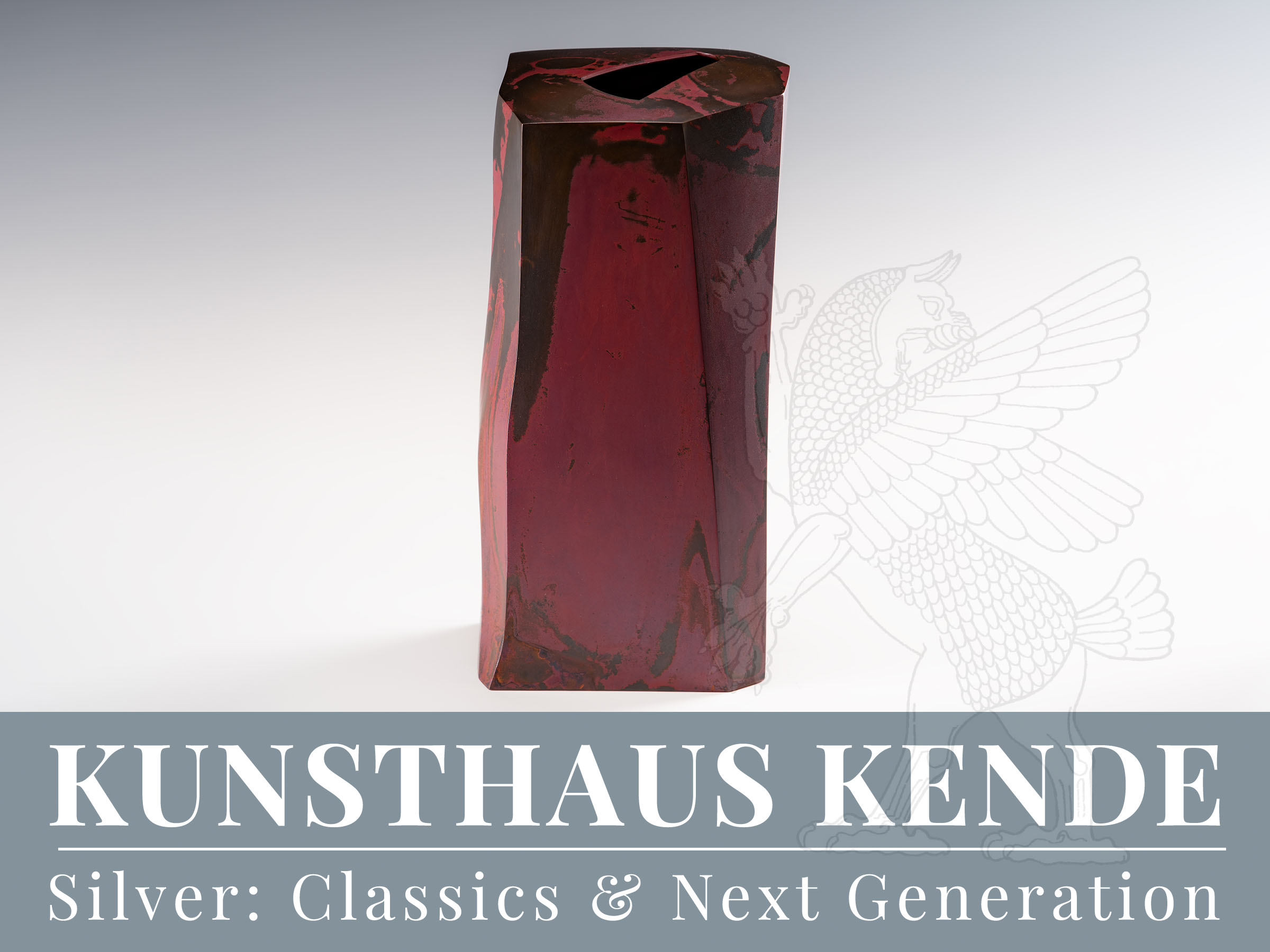
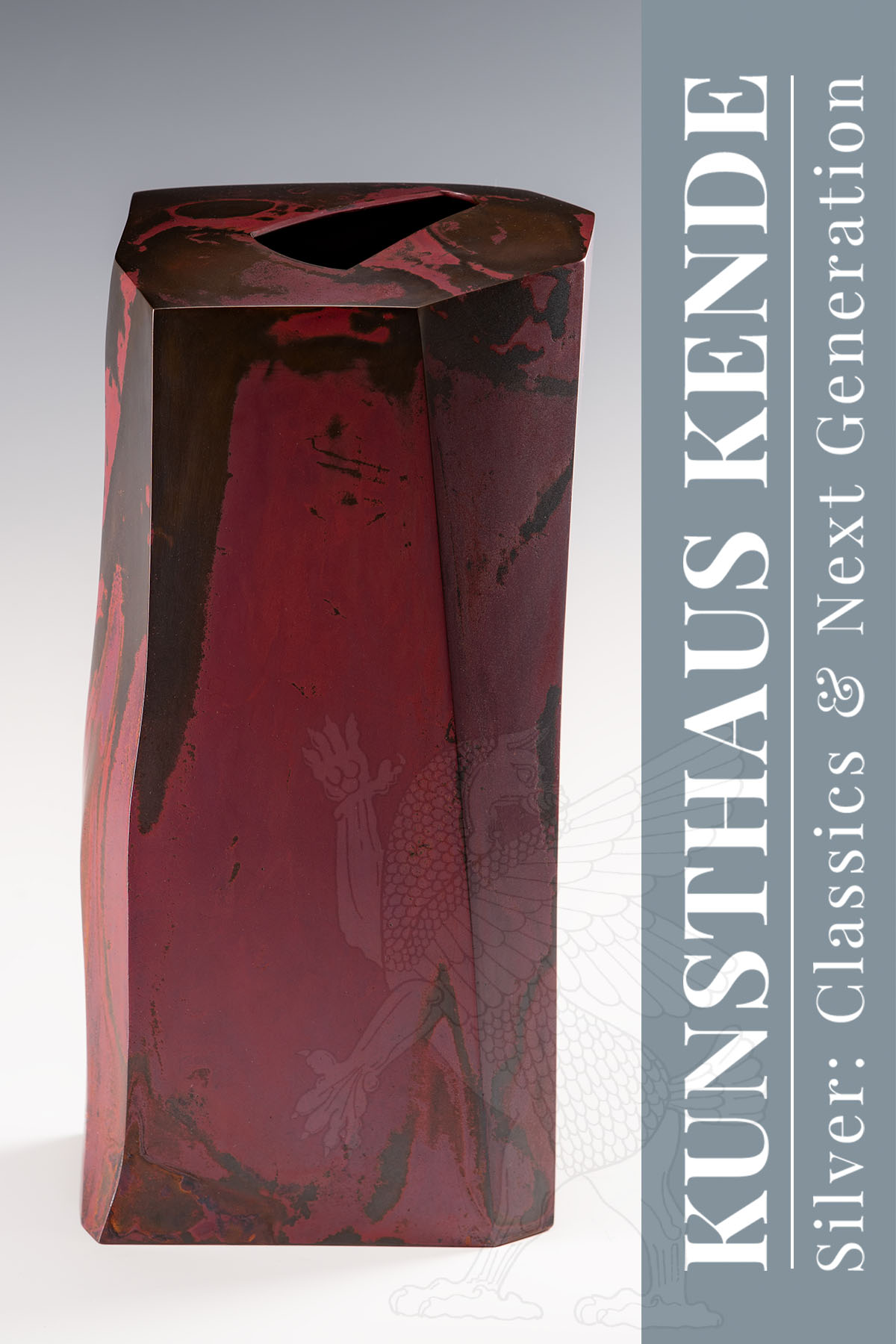
The body, shaped as a vertically elongated, rectangular column with a slightly tapering profile and irregularly faceted sides, rests on a slightly flattened base and is surmounted by a polygonally modelled upper surface with a narrow horizontal opening. The plastically articulated walls are structured by surfaces of varying widths, alternately gently convex and concavely receding, whose organically flowing transitions lend a lively dynamism to the otherwise rigorously ascending form. The surface displays a finely nuanced palette of dark red and violet tones, interspersed with black areas and occasional metallic lustre. The irregularly distributed, cloud-like colour fields, merging into one another, together with the dark, in places mottled structures, create a striking contrast with the smoother, more highly reflective areas.
18.0 cm / 7.1″ width, 12.0 cm / 4.7″ depth, 35.0 cm / 13.8″ height
Shidō (紫銅) is distinguished by its characteristic dark reddish-violet to purplish colouration, which lends the material a particular aesthetic expressiveness. Its nuanced surface appearance results from the interplay between its metallurgical composition and the deliberate treatment of the metal surface. Traditional Japanese metalworking employs various techniques of patination and thermochemical colouring, through which controlled oxidation processes and repeated surface treatments produce differentiated hues and subtle tonal transitions.
The resulting patina displays a lively, light-dependent colouration, ranging from deep reds and purples to dark, almost black nuances. Irregular concentrations of colour, gentle tonal transitions and occasional areas of metallic lustre lend each work an individual surface character. The combination of the material’s inherent qualities, artisanal refinement and deliberately cultivated colour effects makes Shidō a particularly expressive medium within the tradition of Japanese metal art.
The Japanese metal artist Yasuyoshi Matsumoto
The Japanese metal artist Yasuyoshi Matsumoto (松本育祥, born 1982) works at the intersection of traditional Japanese metalworking and contemporary form. At the centre of his artistic practice is the technique of metal casting, Chūkin (鋳金), which he employs primarily in the creation of vessels, bowls and sculptural objects.
His works are distinguished by an exceptionally sensitive approach to the material properties of copper alloys. Among the materials he uses are Shidō (紫銅), a reddish-violet copper alloy, Shudō (朱銅), a copper alloy with reddish hues, and Rōgin (朧銀), a traditional copper alloy characterised by its silvery-grey appearance.
The coloration of his works is achieved not merely through the choice of metal, but through a carefully controlled and elaborate process involving the application of heat and subsequent chemical reactions. By precisely heating the metal and treating its surfaces through subsequent processes, Matsumoto develops differentiated colour tones and richly nuanced patinations. The surface thus becomes an independent element of artistic expression, bringing forth the depth, lustre and vibrant structure of the material. His working process consequently combines two distinct aspects of craftsmanship: the shaping of the object through casting and the deliberate development of its surface appearance through thermal and chemical treatments. It is only through the interplay of these processes that the metal acquires its characteristic appearance.
In this way, Yasuyoshi Matsumoto carries a Japanese craft tradition passed down through generations into an independent contemporary artistic language. His works are not merely functional vessels or decorative objects, but rather explorations of the relationship between material, light and colour.