Item number: 60240
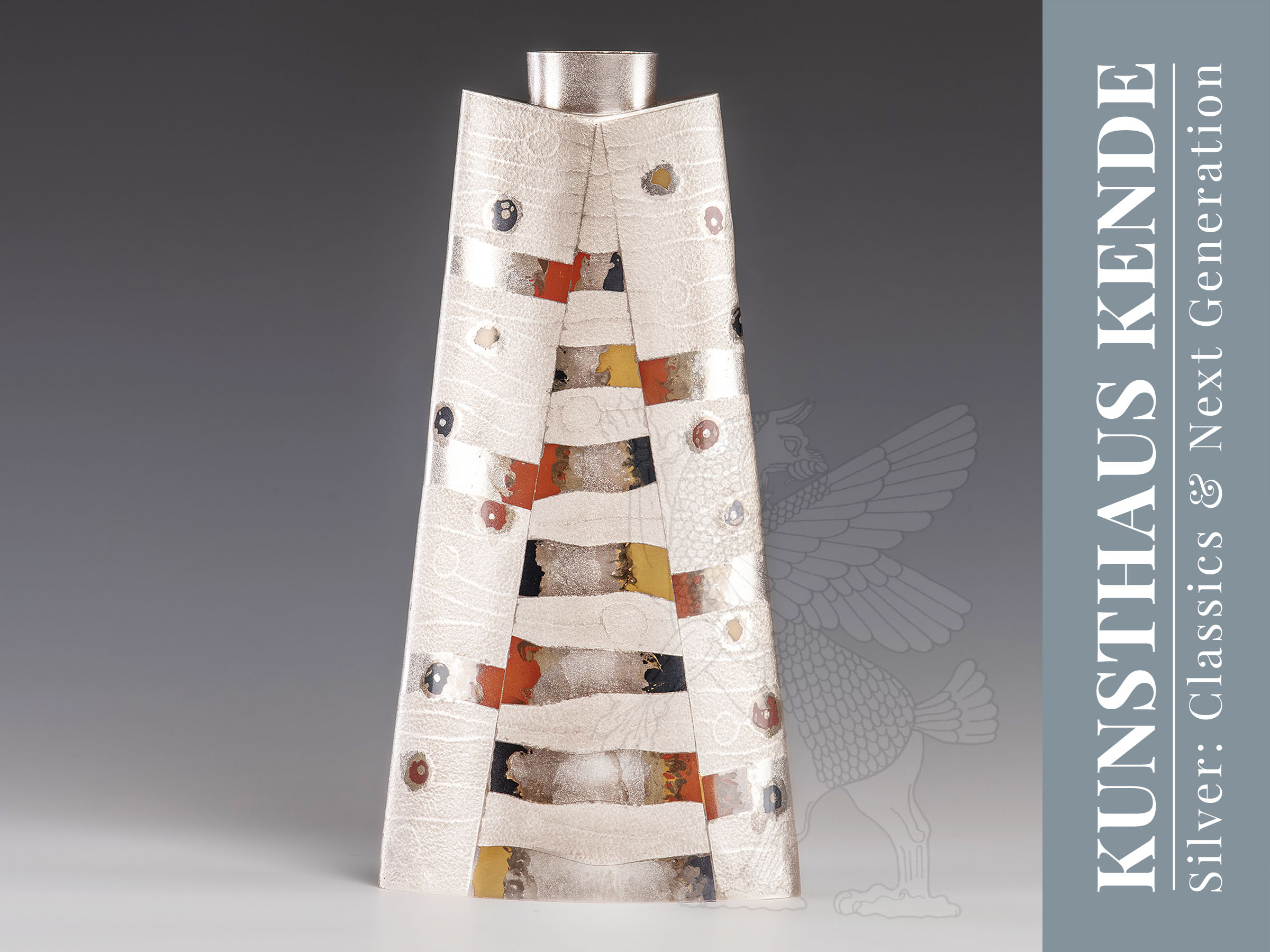
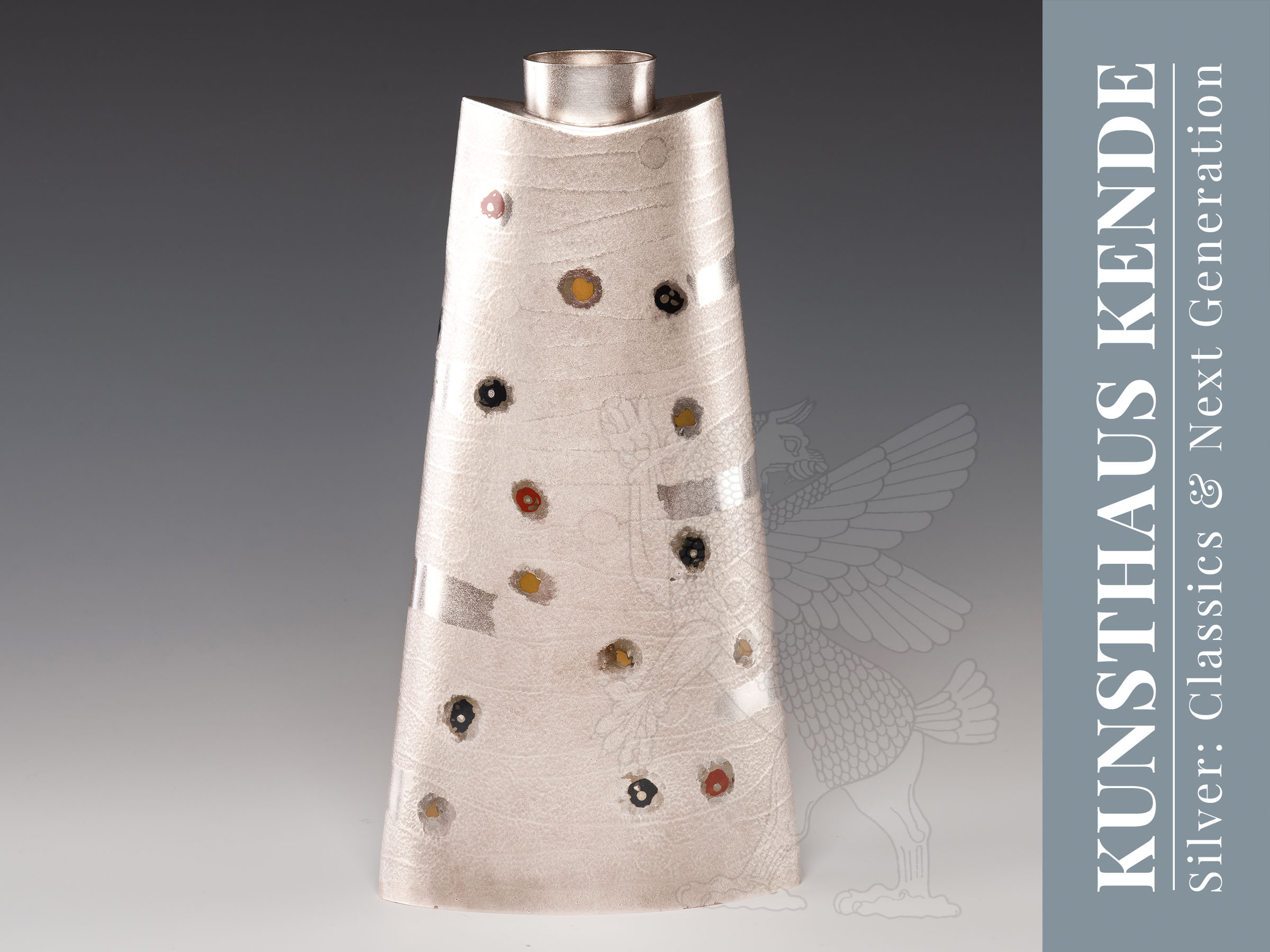
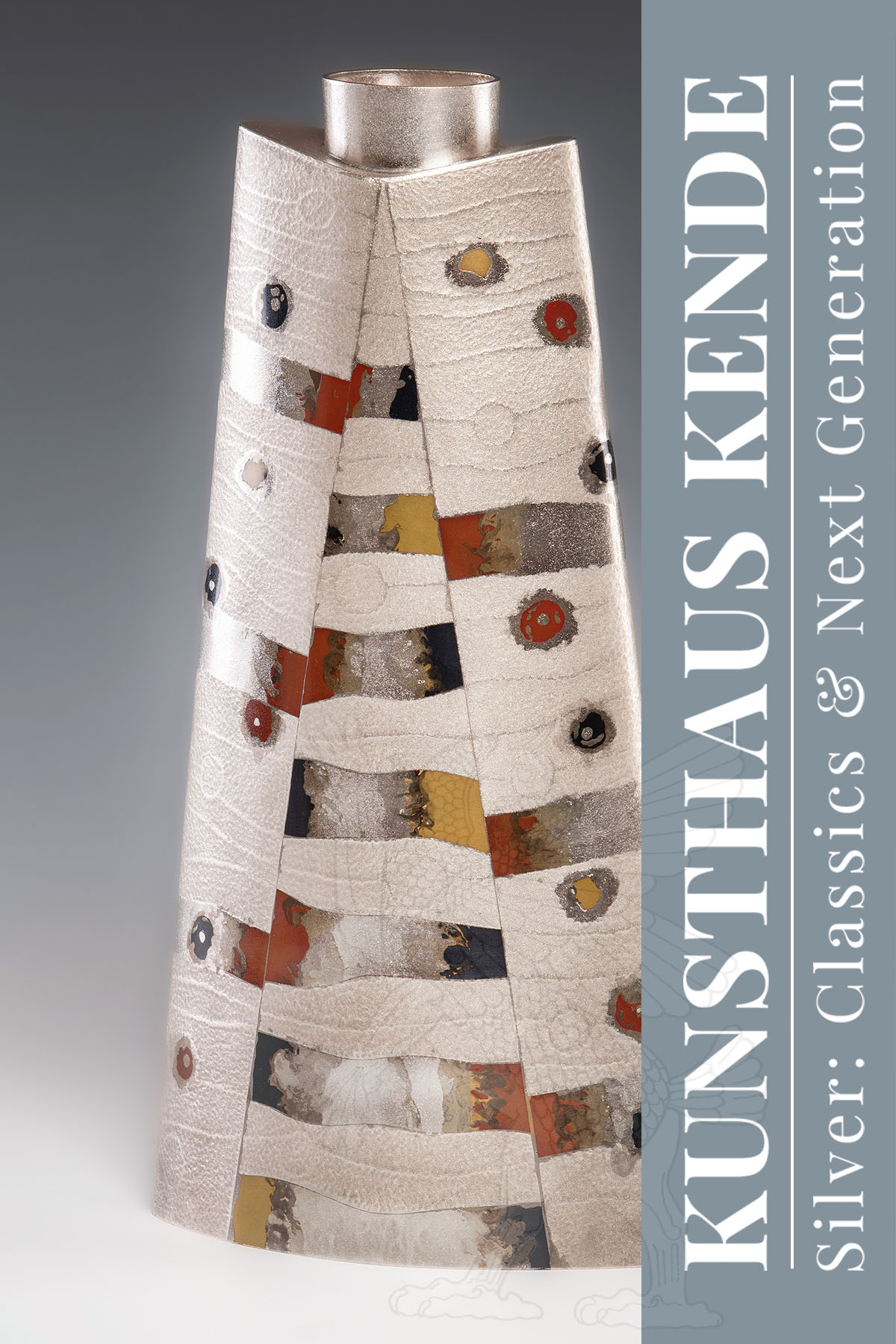
An fine vase in Kakuhanmon vase ゆうなぎ (Yūnagi) – Windless Evening Calm,
Silver, shakudō, copper, brass,
Yamanashi 2022 by Motoko Oshiyama
The body, oval in cross-section and tapering markedly towards the rim, is surmounted by a centrally angled shoulder from which the cylindrical neck emerges.
The surface of the body is covered with a subtle martelé finish, the untouched areas forming smooth linear and circular motifs. The body is composed of ornamental bands and circular configurations, executed using the intricate Kakuhanmon technique developed by the artist.
Width: 14.7 cm / 5.8″, Depth: 7.0 cm / 2.8″, Height: 27.0 cm / 10.6″
The vase was exhibited in 2022 as part of the 62nd East Japan Traditional Crafts Exhibition (第62回東日本伝統工芸展, Dai 62-kai Higashi Nihon Dentō Kōgei-ten).
Kakuhanmon – The Stirring Pattern
The Japanese metal artist Motoko Oshiyama (押山元子) developed the Kakuhanmon (攪拌文), or ‘stirring pattern’, technique and has been exploring its artistic possibilities since 2002. At its heart lies the deliberate fusion and partial intermingling of different metals, whose interaction gives rise to unique, organic-looking patterns and nuanced transitions of colour.
Motoko Oshiyama employs a range of metals and alloys in her work, including fine silver, shakudō (a traditional Japanese copper-gold alloy), copper and brass. Using argon arc welding, she locally melts the metals and manipulates the molten pool with the welding torch. The mixing process is deliberately interrupted before the metals become fully amalgamated. Repeated melting and manipulation produce distinct alloyed areas, whose composition and transitions determine the resulting pattern. The material is subsequently consolidated through careful hammering and worked into a smooth, even metal surface.
Working with different metals presents particular challenges in terms of technical skill and precision. Their differing melting points and thermal conductivities make uniform, controlled mixing difficult to achieve. Silver and copper, for instance, conduct heat particularly rapidly, while brass, depending on its composition, melts at comparatively low temperatures. As a result, certain areas may begin to melt prematurely while others remain solid. Further complications arise from differences in fluidity, as well as the risk of cracking and trapped air inclusions. The challenge lies in controlling the heat input and the movement of the molten pool with sufficient precision to bring the metals together while largely preserving their individual material characteristics and colour potential.
Only through the final application of the traditional Japanese niiro colouring process, a specialised method of colouring metal surfaces by boiling, does the work reveal its characteristic palette. The different metals and alloyed areas each respond in their own way, developing a nuanced spectrum ranging from pale silver and gold tones to reddish and brownish hues, and extending to deep browns and blacks. The colour is neither applied nor introduced as a subsequent finish; rather, it emerges directly from the composition of the material itself.
Oshiyama’s development of Kakuhanmon originated in her search for a means of artistic expression through which landscapes and natural structures could be depicted in conjunction with animal motifs. In her view, conventional techniques tended either to produce effects that were too soft and restrained or too sharply defined and rigid. An initially accidental intermingling of silver and shakudō during argon arc welding led to her discovery of new intermediate metallic hues and became the starting point for systematic experiments in combining different metals.
The distinctive quality of Kakuhanmon lies in the interplay between deliberate artistic intervention and the unpredictable behaviour of the material. The differing melting and flow characteristics of the metals used influence the process, lending the resulting structures their individual character. Through heat, movement and repeated fusion, flowing lines, dynamic transitions and complex, layered patterns emerge, evoking landscapes, the movement of water and geological formations.
Motoko Oshiyama thus brings together modern welding technology and traditional Japanese metalworking and surface-treatment techniques. The metal itself becomes the picture plane: its inherent properties, colour and internal structure serve as the artist’s primary means of expression. Kakuhanmon is therefore far more than a technical process; it is an independent visual language in which technical precision, a spirit of experimentation and the inherent beauty of the material converge in a poetic interpretation of nature.
Japanese metal artist Motoko Oshiyama
Following her graduation from Bunka Gakuen University in Shinjuku, Tokyo, in 1981, Motoko Oshiyama (b. 1957) went on to refine her technical skills under the guidance of Katsura Moriyuki (1914–1996) and Okuyama Hōseki (b. 1935), who holds the prestigious designation of Living National Treasure.
Influenced by her distinguished mentors, the artist specialised in silver metalwork, often combining silver with a variety of other metals. Her preferred subjects are the distinctive natural phenomena and landscapes of Japan, frequently incorporating depictions of the country’s rich flora and fauna.
The colouration of her metalwork is distinguished by a sensitive balance between harmony and chromatic intensity. Her principal technique is Kakuhanmon, for which she holds a patent. In addition, she employs a wide range of chasing and soldering techniques, exploring further possibilities of artistic expression through their combination.
Today, the artist teaches metalworking techniques at Bunka Gakuen University (文化学園大学) in Tokyo. Motoko Oshiyama is a permanent member of both the Japan Kogei Association and the Yamanashi Art Association.
Awards (selection):
1996: Incentive Award at the 36th Exhibition of New Works of Traditional Art Crafts
2001: 18th Tansuiou Prize
2003: Japan Kogei Association Award at the 32nd Japanese Traditional Metalwork Exhibition
2010: 50th Anniversary Award at the 50th East Japan Traditional Kogei Exhibition (with the work presented here)
2014: Tokyo Board of Education Award at the 43rd Japanese Traditional Metalwork Exhibition
Public collections: A lidded box by the artist is in the Metropolitan Museum of Art, New York (see here). Works by Motoko Oshiyama are also in the National Museum of Asian Art at the Smithsonian Institution, Washington, and the Ise Cultural Foundation, New York.