Item number: 60213
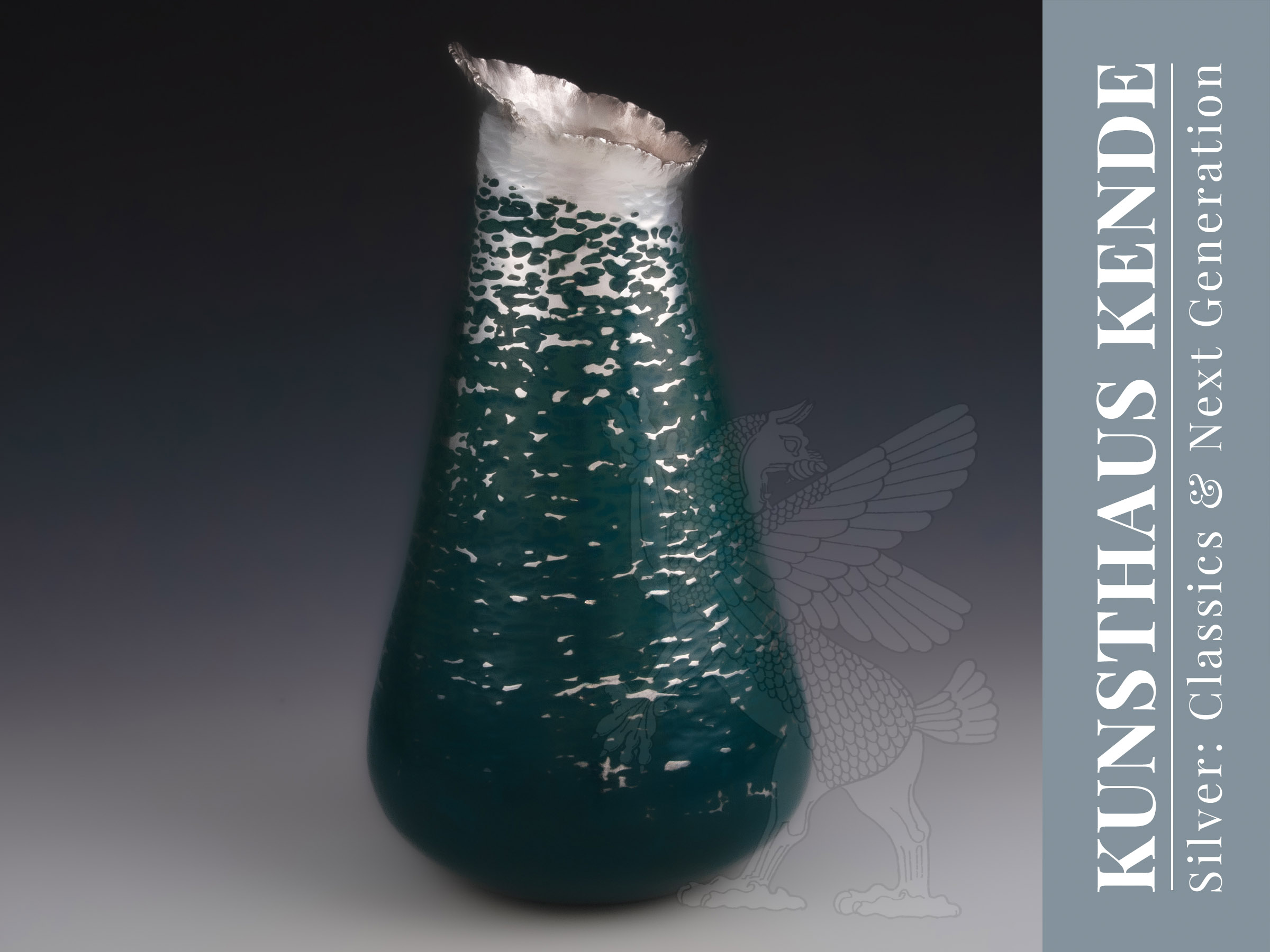
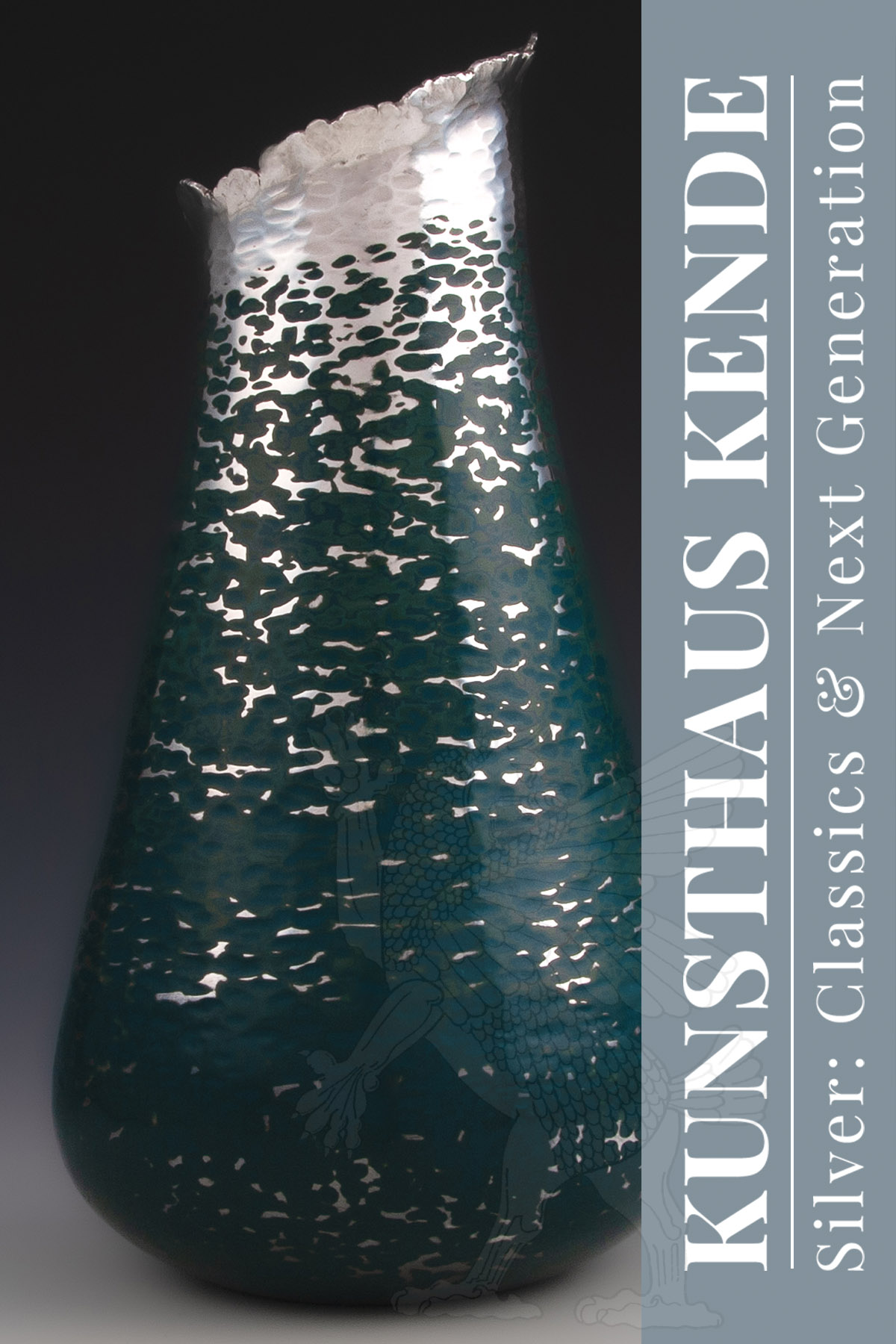
Modern fine silver and Urushi lacquer decanter ‘Blue Water Jug’,
Antwerp 2017, made by Georges Cuyvers (silver) and Carolien Cuyvers (Urushi lacquer)
Rounded body tapering strongly towards the neck, which merges into the openwork rim at the spout.
An elegant decanter crafted with great sophistication in fine silver, whose hammered finish is adorned with blue urushi lacquer in the recesses, creating a visual effect of water reflections.
This piece is a collaborative work by Georges Cuyvers and his daughter Carolien Cuyvers.
26.1 cm / 10.27″ tall; 1065.4 g / 34.25 oz
Georges Cuyvers – Designer, goldsmith and silversmith
Georges Cuyvers lives and works as a goldsmith, silversmith and designer in Antwerp.
He studied at the Royal Academy of Fine Arts (Koninklijke Academie voor Schone Kunsten van Antwerpen) from 1970-76 and with Piet Hye from 1973-77. From 1979-82 he taught at the Stedelijke Nijverheidsschool in Antwerp. From 1986 to 2016, he taught as a professor of design, goldsmithing and silversmithing at the Royal Academy of Fine Arts and is now a freelance artist. Among other activities, he is co-founder of the ” EUSILVA v.z.w. ” – European Silver Association, a Belgian association for the promotion of contemporary silversmithing, as well as the ” DE VLAAMS-TSJECHISCHE- EN SLOVAAKSE VERENIGING v.z.w. “, an association for the cultural promotion and exchange of contemporary art.
Georges Cuyvers is one of Belgium’s most important actors in contemporary design and silversmithing and can look back on a large number of solo exhibitions in Europe and abroad. His works are also presented at Brafa (Brussels) and Tefaf (Maastricht), among others.
Carolien Cuyvers – Goldsmith, engraver and lacquer artist
As the daughter of Georges Cuyvers, Caroline Cuyvers (born in 1982) grew up with gold- and silversmithing from an early age.
During her training at the Royal Academy of Fine Arts in Antwerp, which she completed with a master’s degree in goldsmithing, she was first introduced to Japanese lacquer art by Jean Lemmens (1945-2024).
She remained connected to this art form still today, more than 20 years later, and has become a specialist in the field.
Japanese lacquer (urushi) is the sap of the lacquer tree, which is native to several East Asian countries such as Thailand, Japan, Korea and China. There are many types of lacquer trees, one of the most important varieties being called Rhus.
The lacquer does not dry, but hardens by absorbing water molecules (polymerisation), which is why lacquered objects are stored in a dust-free location to cure. Ideal conditions for hardening are 90% humidity and a temperature of 30 °C. For this reason, objects coated with urushi lacquer used to be taken out to sea on rafts to harden, as the concentration of dust is also very low above the sea. Hardening can take from hours to days.
Urushi lacquer can be applied to all kinds of materials, such as wood, copper, tin, dried clay, porcelain, gold and silver, and even leather and textiles. The lacquer must be applied in many very thin layers, otherwise it will not harden. This is done with a brush (Japanese: Hake) made entirely of human hair. Dust is the biggest problem when producing Urushi coatings. A freshly lacquered piece is therefore placed in the Muro, a wooden cabinet whose interior is kept warm and humid, to harden. After hardening, each layer is sanded and polished. The colour of the lacquer was mainly achieved using metal oxides, although synthetic pigments have also been used increasingly in recent times. Vegetable pigments are usually affected by the lacquer. Other techniques sometimes used in urushi include inlaying eggshells and mother-of-pearl or sprinkling with metal powder.