
Item number: 60247
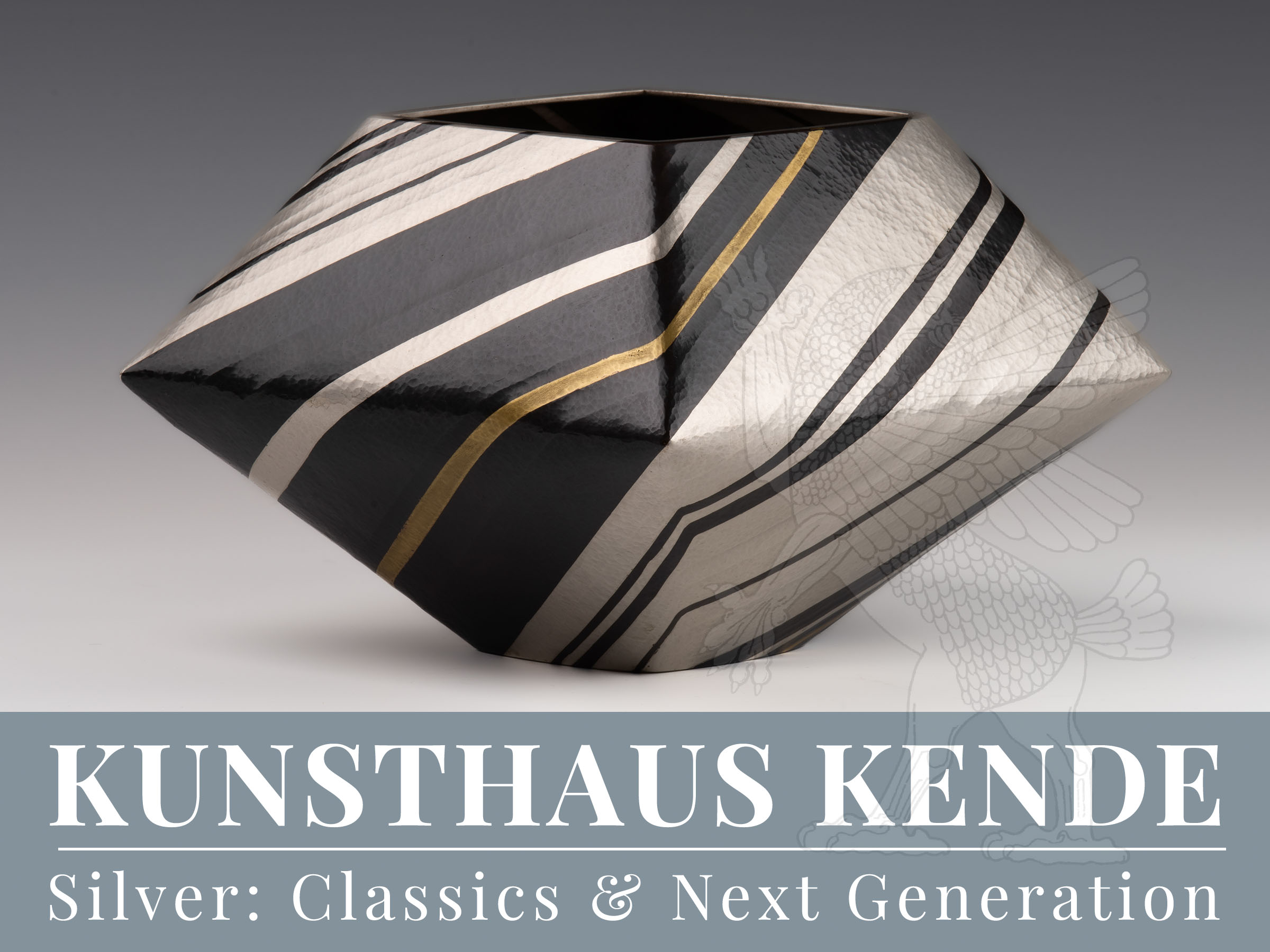
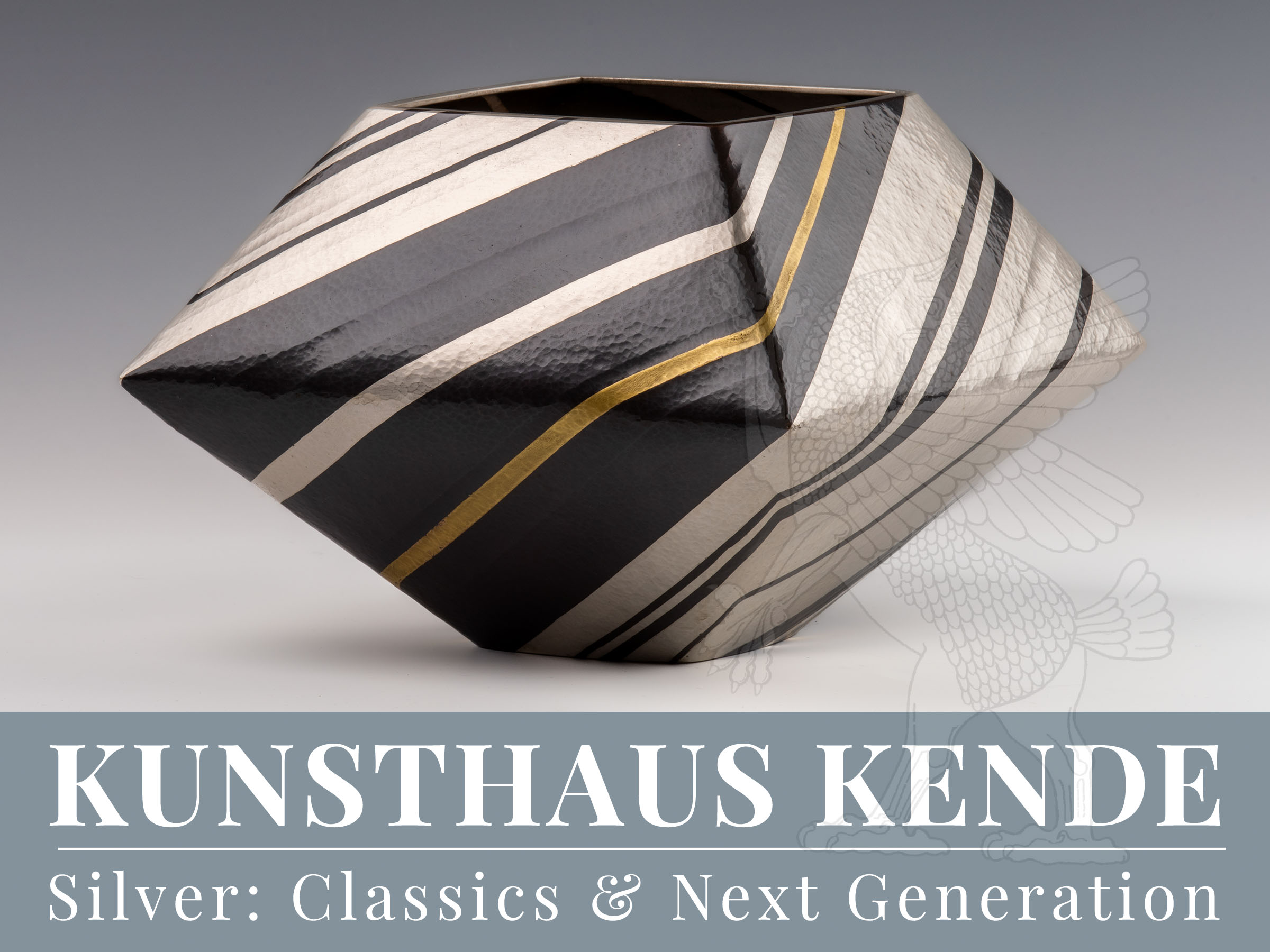
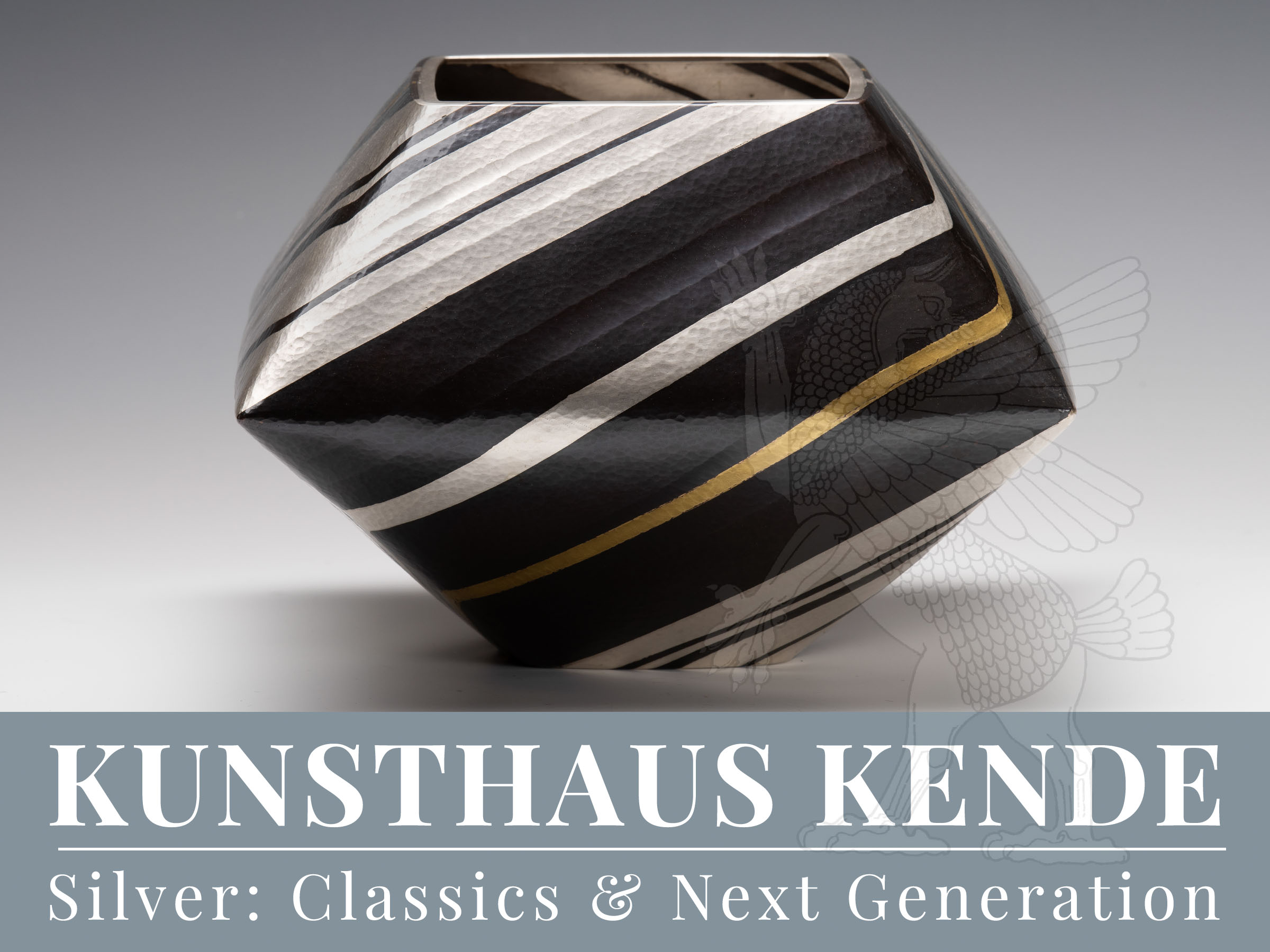
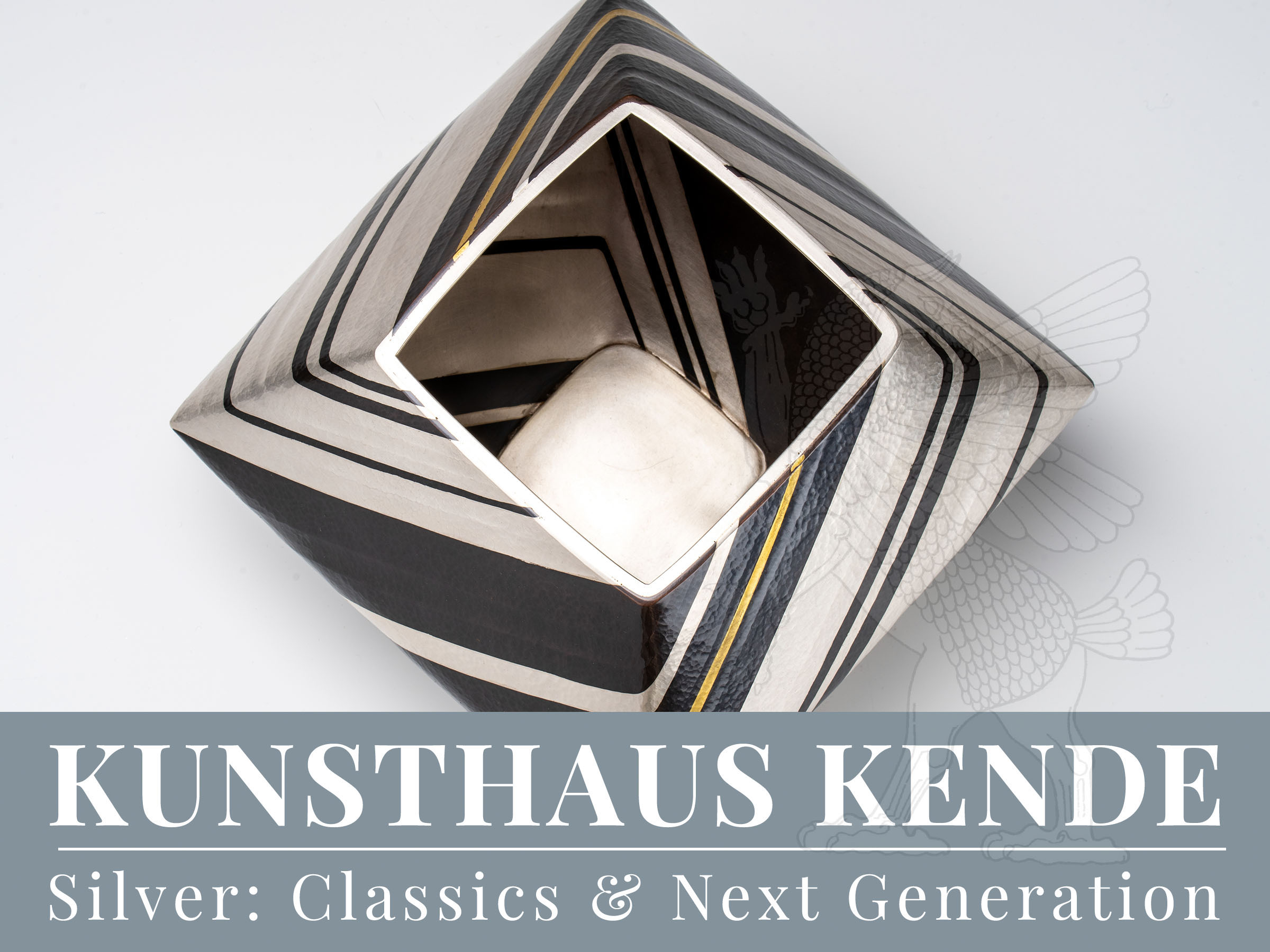
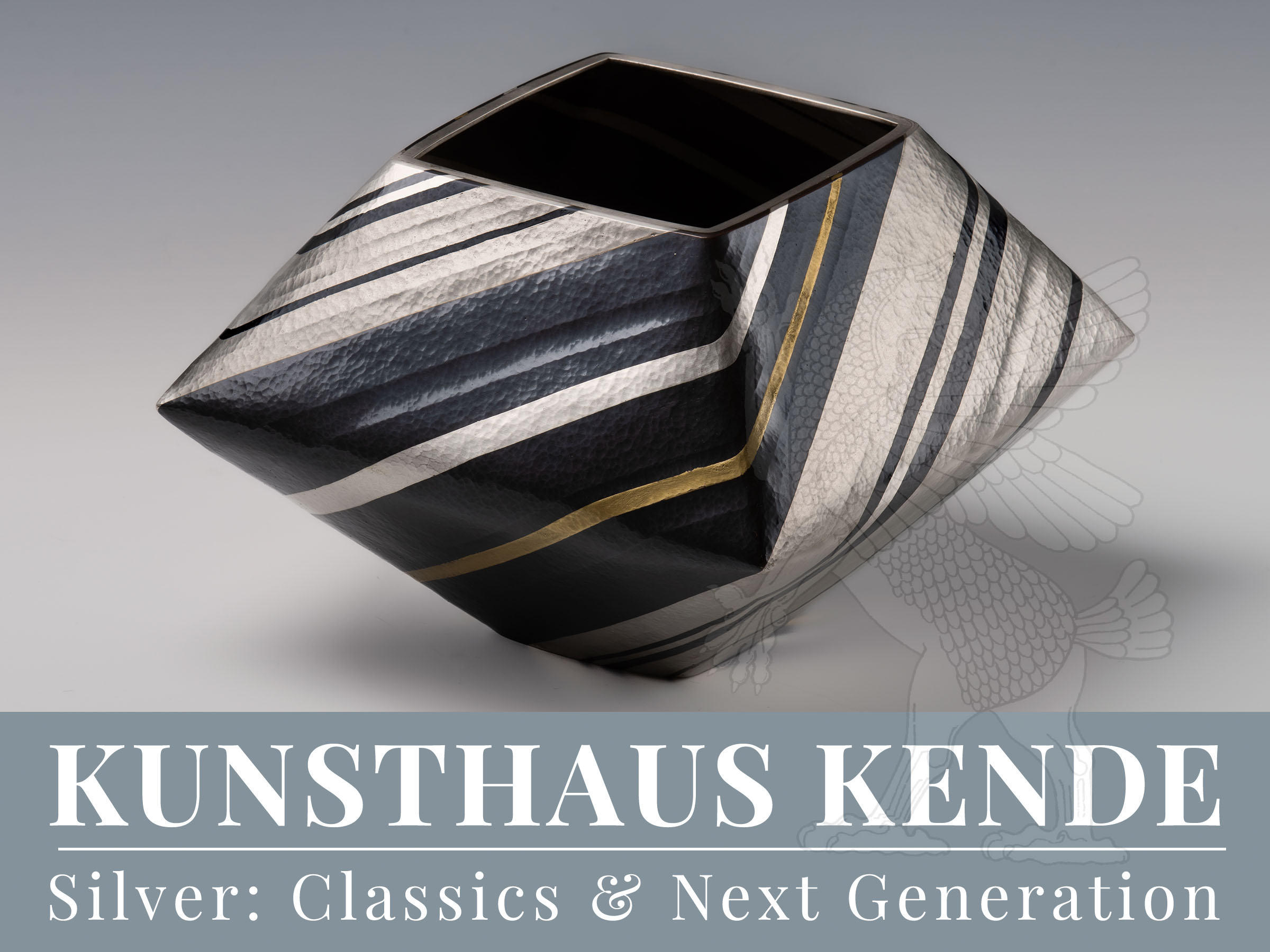
Expressive vase in Hagiawase 宝形 (Hōgyō) – Hōgyō,
Silver, shakudō, kuromidō, gold overlay,
Saitama 2012 by Noriko Hagino
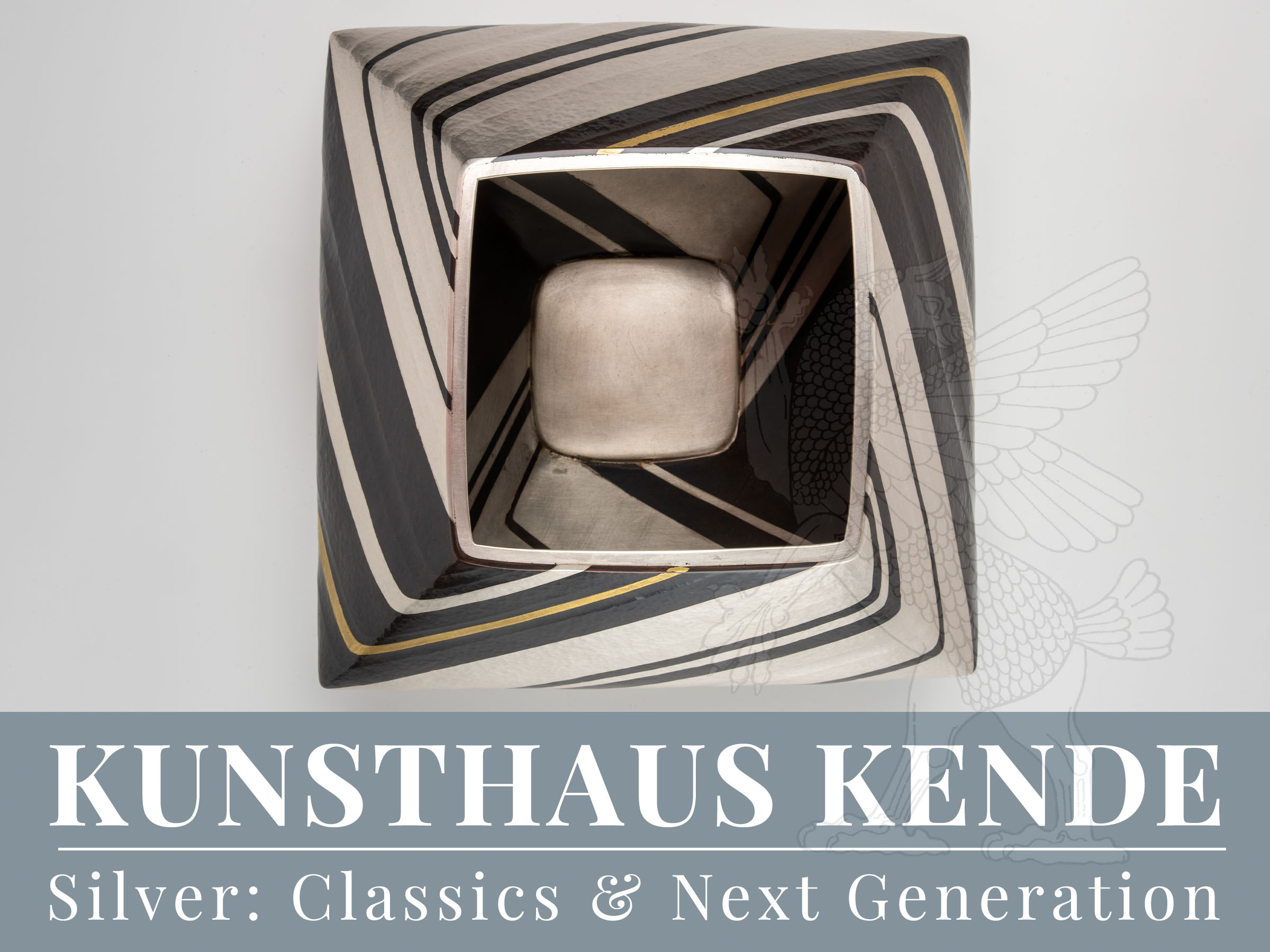
The strikingly double-pyramidal body, its entire surface covered in a finely textured martelé finish, rises from a narrow square foot, expanding outwards towards a sharply defined angular transition at mid-height before tapering inwards to a recessed square aperture with a smooth, crisply finished rim. The four faces of the vessel are articulated by a dynamic pattern of diagonal bands extending across the edges. Their luminous silver surfaces alternate with the deep, dark tones of shakudō and kuromidō, interspersed with accents of traditional gilding, creating a compelling interplay of light and shadow. The nuanced colouration of the combined metals lends the object exceptional depth and elegance, whilst the vessel’s rigorously geometric form creates a striking contrast with the animated surface treatment and vibrant interplay of colour.
An exceptional work from the Hōgyō series by the Japanese metal artist Noriko Hagino, in which the sophisticated traditional joining technique of hagiawase is combined with a distinctly contemporary, sculptural formal language.
The title Hōgyō (宝形) refers to a traditional roof form found in Japanese temple architecture. Known as hōgyō-zukuri, this architectural style is characterised by a square ground plan surmounted by four sloping roof planes that converge at a single apex, without the formation of a horizontal ridge. This pyramidal roof construction, employed particularly in Buddhist halls and temple buildings, is distinguished by its harmonious symmetry and lucid, pared-back geometry.
In this eponymous metalwork, Hagino translates the architectural form into an independent sculptural expression. The precisely interrelated planes and the sharply defined lines rising towards the apex lend the vase a remarkable sense of composure and formal coherence. At the same time, its geometric clarity gives rise to a compelling spatial presence, in which the architectural reference and the artist’s contemporary formal language are brought together with remarkable eloquence.
*Dimensions to follow*
Hagiawase (矧合) – A Traditional Japanese Metalworking Technique
The Hagiawase technique employed by Noriko Hagino is a sophisticated method of Japanese metalworking in which strips of differently coloured metals are joined by hard soldering and subsequently shaped through repeated hammering and forging. The metals most commonly used include silver, shakudō – a copper-gold alloy with a characteristic dark patina – and kuromidō, blackened copper.
The distinctive feature of this technique lies in the repeated alternation between soldering and hammering. The individual metal strips are first carefully arranged, secured and gradually soldered together. The resulting composite surfaces are then shaped using wooden and metal hammers on specialised stakes. As the different metals respond differently to heat and mechanical stress, each stage of the process requires a high degree of experience and precision. Repeated soldering, forging and finishing are necessary to achieve a permanently stable bond and a uniform surface.
The Hagiawase technique derives its distinctive effect from the interplay of the different metal colours. The precisely assembled strips form a continuous, vividly structured linear pattern, whose flow and rhythm are largely determined by the subsequent shaping process. Only in the final stages, through careful grinding and the traditional colouring process using a niiro bath, do the metals acquire their characteristic hues and the soldered joints become fully integrated into the overall design.
Hagiawase thus combines the structural precision of an elaborate joining technique with the artistic possibilities of traditional Japanese metal forming. Mastery of the process requires not only an extensive understanding of the properties of the materials but also a highly developed spatial imagination, as the initially flat arrangement of lines acquires its final three-dimensional appearance only through the hammering and shaping process.
Noriko Hagino (萩野紀子) – Education and Artistic Career
Born in 1949 in Gyōda, Saitama Prefecture. In 1971, she completed the advanced course at Musashino Art Junior College. In 1975, she began her artistic training under Shirō Sekiya (1907–1994), one of Japan’s most distinguished metal artists and a recipient of the title “Living National Treasure”.
Through her engagement with traditional Japanese metalworking, Hagino developed an individual artistic language, focusing in particular on the techniques of metal forming (鍛金, tankin) and the joining of dissimilar metals (矧合せ, hagiawase). Her work is characterised by the compelling interplay of differently coloured metals, whose linear patterns and rhythmic arrangements she employs as essential elements of her artistic expression.
Her work has received numerous awards at major Japanese exhibitions of arts and crafts. These include the Encouragement Award at the Shinshō Kōgei Exhibition in 1995, the Takada Makoto Prize at the Saitama Prefectural Exhibition in 1999, and the Japan Kōgei Association Award at the 63rd Japan Traditional Kōgei Exhibition in 2016. In 2004, her work was presented as part of the exhibition “Contemporary Japanese Metalwork” at the Royal Danish Museum of Decorative Art in Copenhagen.
Hagino is a full member of the Japan Kōgei Association (日本工芸会正会員) and is recognised as one of the leading figures in contemporary Japanese metal art.
PRICE ON APPLICATION