Item number: 60246
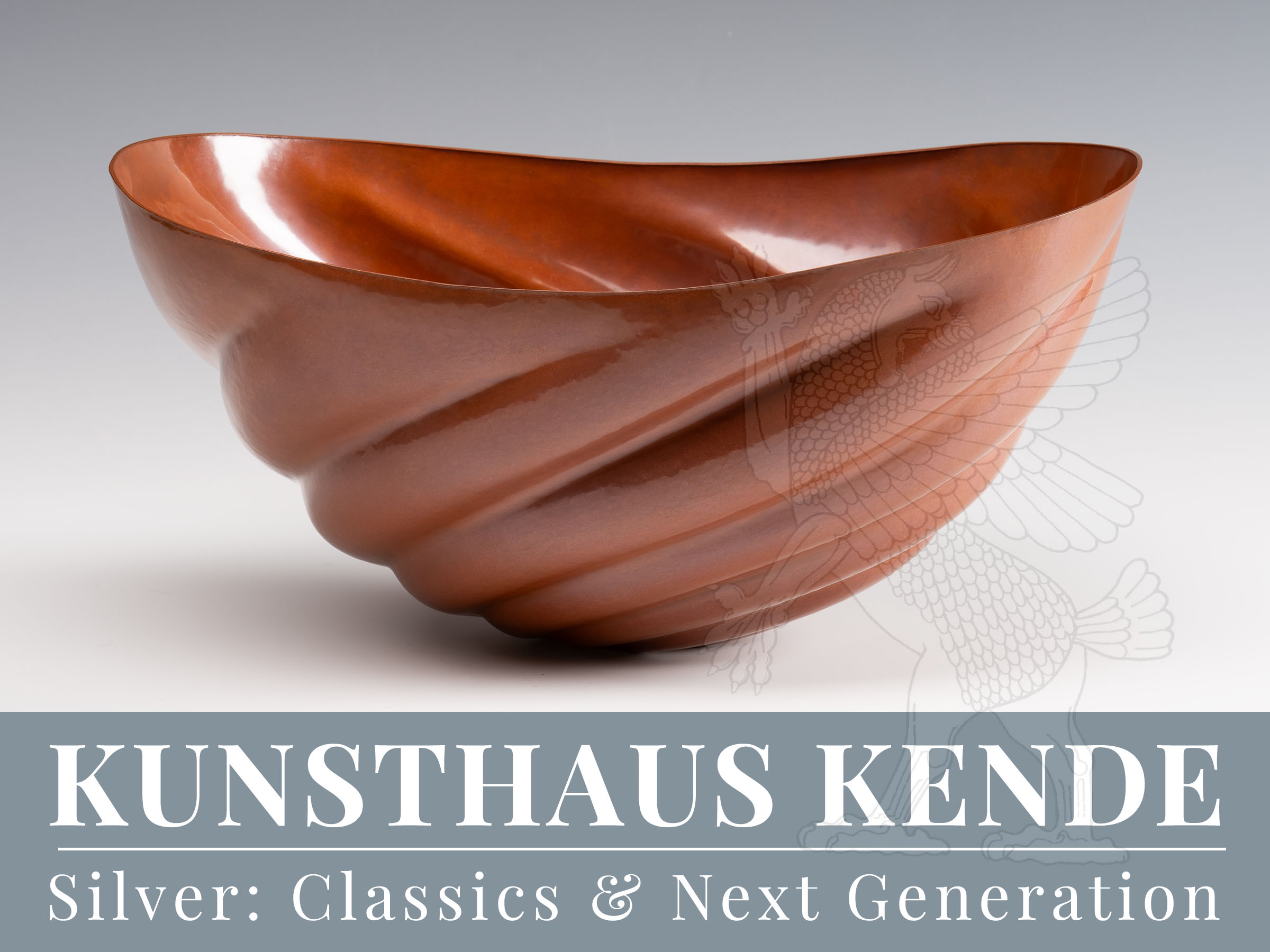
A sculptural „Whirl Boat Vessel“,
Raised and patinated copper,
Tōkyō 2023 by Koichi Io
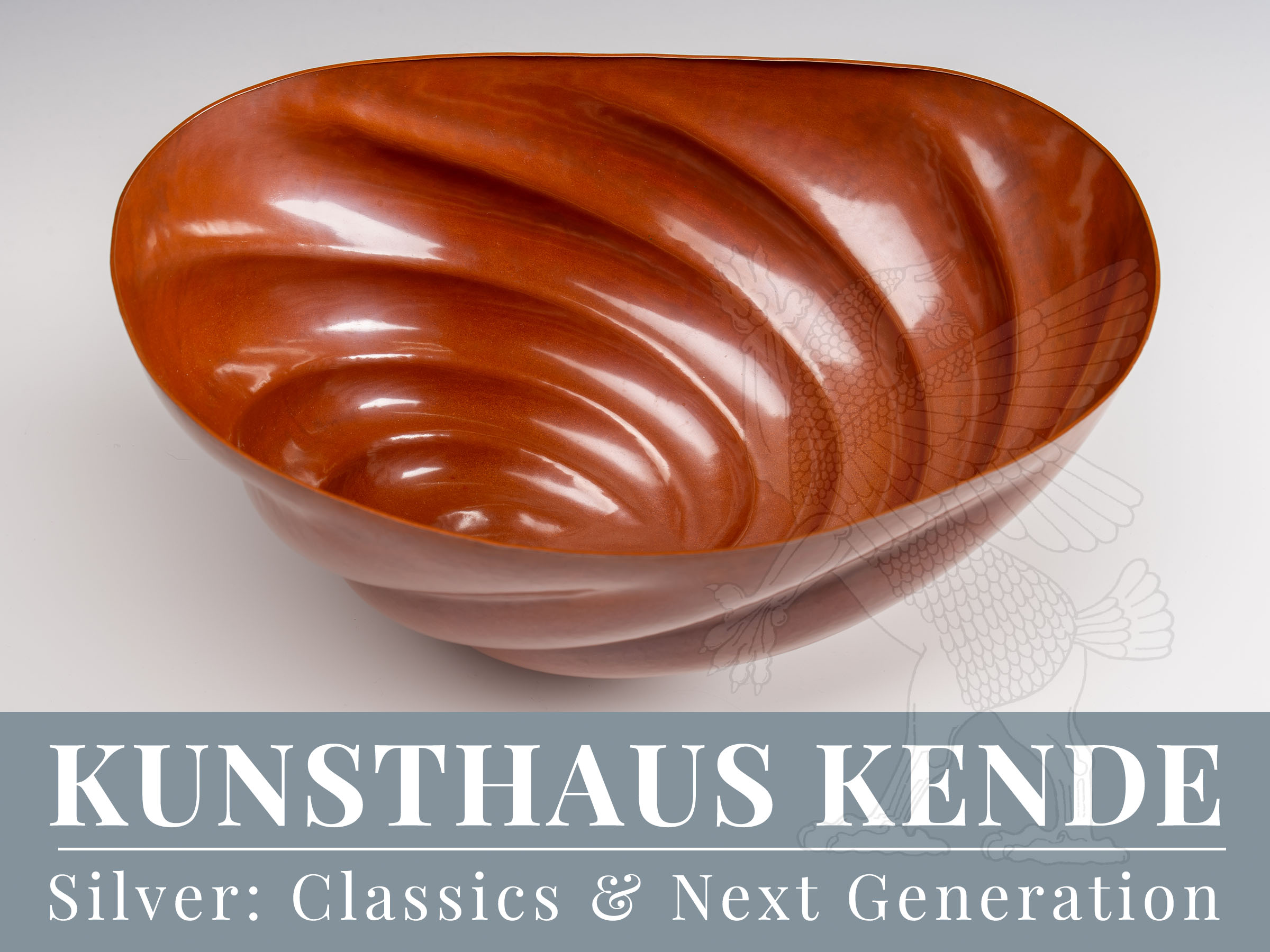
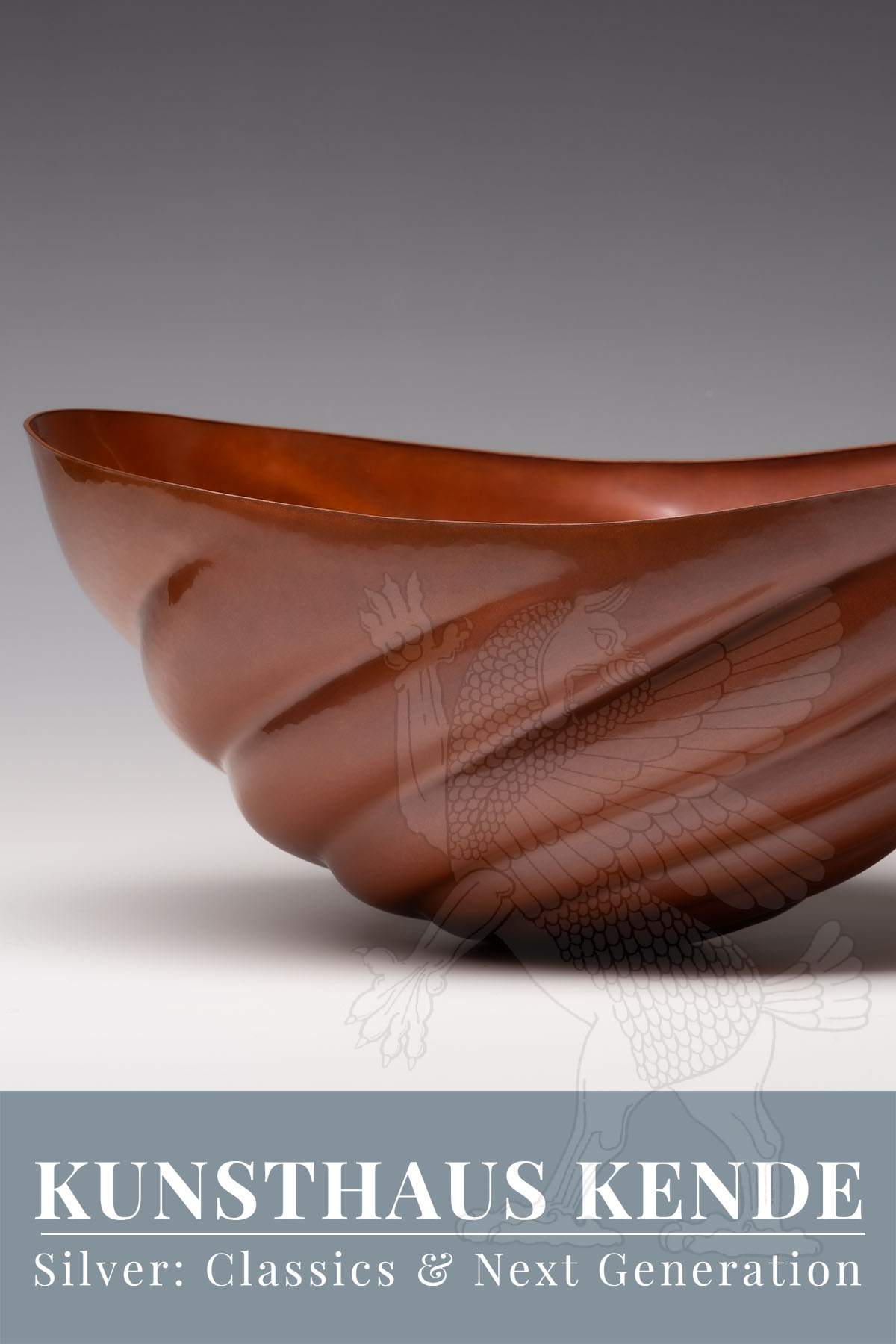
The asymmetrical, elongated bowl form features a gently flowing outline and an irregularly undulating rim. The body is articulated by spiralling, softly rounded convexities and depressions, created through the hammer-raising technique and extending from the base to the rim. The polished, copper-red surface produces a rich interplay of light and reflection. The vessel tapers towards the base, resting on a narrow, gently rounded foot.
An exceptionally elegant and distinctive work of sculptural character, demonstrating Koichi Io’s masterful command of the traditional Japanese tankin metalworking technique.
34 cm / 13.39″ length, 25 cm / 9.84″ width, 16 cm / 6.30″ maximum height
The “Whirl Boat Vessel” by Koichi Io
Koichi Io’s Whirl Boat Vessel was created from a single flat sheet of copper. What ultimately emerges as a complexly shaped vessel, seemingly almost weightless, is the result of a slow and highly precise process in which material, hand and time are intimately connected. In this work, Io translates the centuries-old Japanese tradition of metalworking, known as tankin (鍛金), into a contemporary formal language.
The starting point is a flat sheet of metal. Using the traditional technique of metal raising, the copper is gradually transformed into a three-dimensional form, hammer blow by hammer blow. The sheet is worked over anvils of various shapes and with different types of hammer. Each strike alters the tension and geometry of the material. The rim is gradually raised, the walls drawn inwards, and the initially simple bowl form becomes increasingly complex. The final shape is not achieved by assembling individual components, but through the continuous transformation of a single piece of metal.
This process demands a constant balance between force and control. Repeated cold working causes the copper to harden, requiring it to be heated at regular intervals to restore its malleability. Hammering and annealing alternate throughout the process, with the form emerging through numerous successive stages of work. The surface retains the traces of this process: the fine indentations and raised areas left by the hammer blows are not merely marks of manufacture, but become an essential element of the work’s aesthetic character.
In the present work, this movement of the hand appears to continue within the finished form. Its contours are not static, but unfold in a spiralling, organic dynamic. The vessel seems to rotate in upon itself, circling its own axis. This sense of movement is neither superimposed nor additive; it arises intrinsically from the properties and manipulation of the material. Through the controlled deformation of the copper, Io creates a form that evokes currents, eddies and organic growth, yet remains entirely rooted in the inherent logic of the worked sheet. The interior is equally integral to this conception. Io gives the inner and outer surfaces the same degree of attention, transforming the vessel into a sculptural body whose full effect unfolds through the interplay between its external contours and internal space. The opening becomes a threshold between two forms, between surface and cavity, between the enclosed volume of the sculpture and the open space it contains.
The final stage of the making process is patination. Rather than being applied as a coating, the colour is produced through a chemical transformation of the copper’s surface. Drawing on traditional Japanese techniques, the metal develops an intense and deep coloration, ranging from warm reds and browns to darker shades. The copper thus relinquishes its purely metallic appearance, acquiring an almost velvety quality, at times reminiscent of lacquer. The patina settles over the hammer-worked surface, revealing its subtle relief. Light and shadow move across the indentations and raised areas; depending on the viewing angle, the perception of colour and volume changes. The chemical treatment of the surface and the mechanical working of the metal are closely interwoven: what initially appears as a trace of the making process becomes an independent expressive element.
It is precisely this synthesis that defines the distinctive quality of Io’s work. Traditional techniques are not preserved as historical processes, but employed as living instruments for contemporary formal exploration. His understanding of the material, the precision of his craftsmanship and the considerable time invested in the making process remain present in the finished object, without reducing it to its technical origins. The Whirl Boat Vessel thus occupies a position at the intersection of vessel and sculpture, craft and art, material and movement. It reveals not only what can be achieved with copper, but also makes the very process of making tangible. Every hammer blow, every deformation and every alteration of the surface bears the imprint of the time required to transform a flat sheet of metal into a sculptural form that appears to have been set in motion.
Koichi Io (井尾 鉱一) – Metal Artist and Designer
Born in 1987 in Tokyo, Koichi Io comes from a family of metalworkers and artists. Both his grandfather and father were engaged in the art of metalworking, and Io acquired his early practical skills in his father’s workshop. In 2009, he graduated from Musashino Art University in Tokyo, specialising in craft and industrial design. He subsequently continued his studies at Seoul National University in South Korea, where he completed a Master’s degree in Design in 2012.
In his artistic practice, Io combines traditional Japanese metalworking techniques with a distinctive contemporary visual language. In particular, the technique of metal raising, known in Japanese as tankin (鍛金), enables him to create sculptural, organic vessel forms. His works are distinguished by their nuanced surface treatments and his precise exploration of the expressive and formal possibilities of metal.
Io achieved international recognition at an early stage in his career. In 2009, he received a Merit Award at the 6th Cheongju International Craft Biennale in South Korea. In 2018, he was awarded the Bavarian State Prize. The following year, he was selected as a finalist for the LOEWE Foundation Craft Prize. In 2020, he received the Newcomer Award at the 67th Japan Traditional Crafts Exhibition. At the 20th International Silver Triennial in 2022, he was also awarded Second Prize in the Lions Club Hanau Young Talent Award.
His works are held in major international museum collections, including the Victoria and Albert Museum in London, the Ashmolean Museum in Oxford and the Smithsonian National Museum of Asian Art in Washington, D.C. Koichi Io is thus part of an internationally recognised generation of Japanese metal artists who bring traditional craftsmanship into a contemporary artistic context.
PRICE ON APPLICATION