Item number: 60206
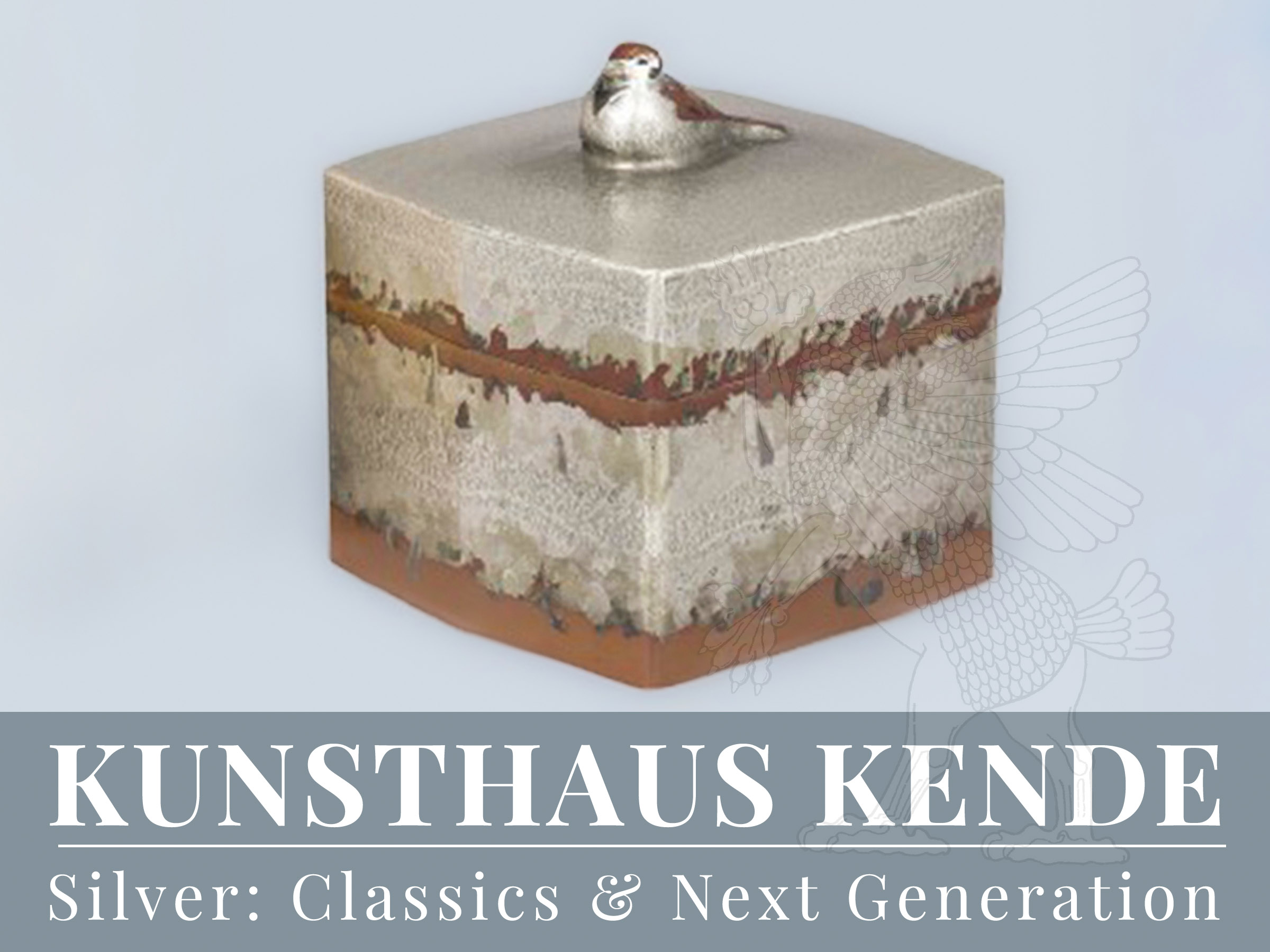
An exceptional lidded Kakuhanmon box “Remaining Snow”,
silver, copper, Shakudo, Shibuichi,
Yamanashi 2010 by Motoko Oshiyama
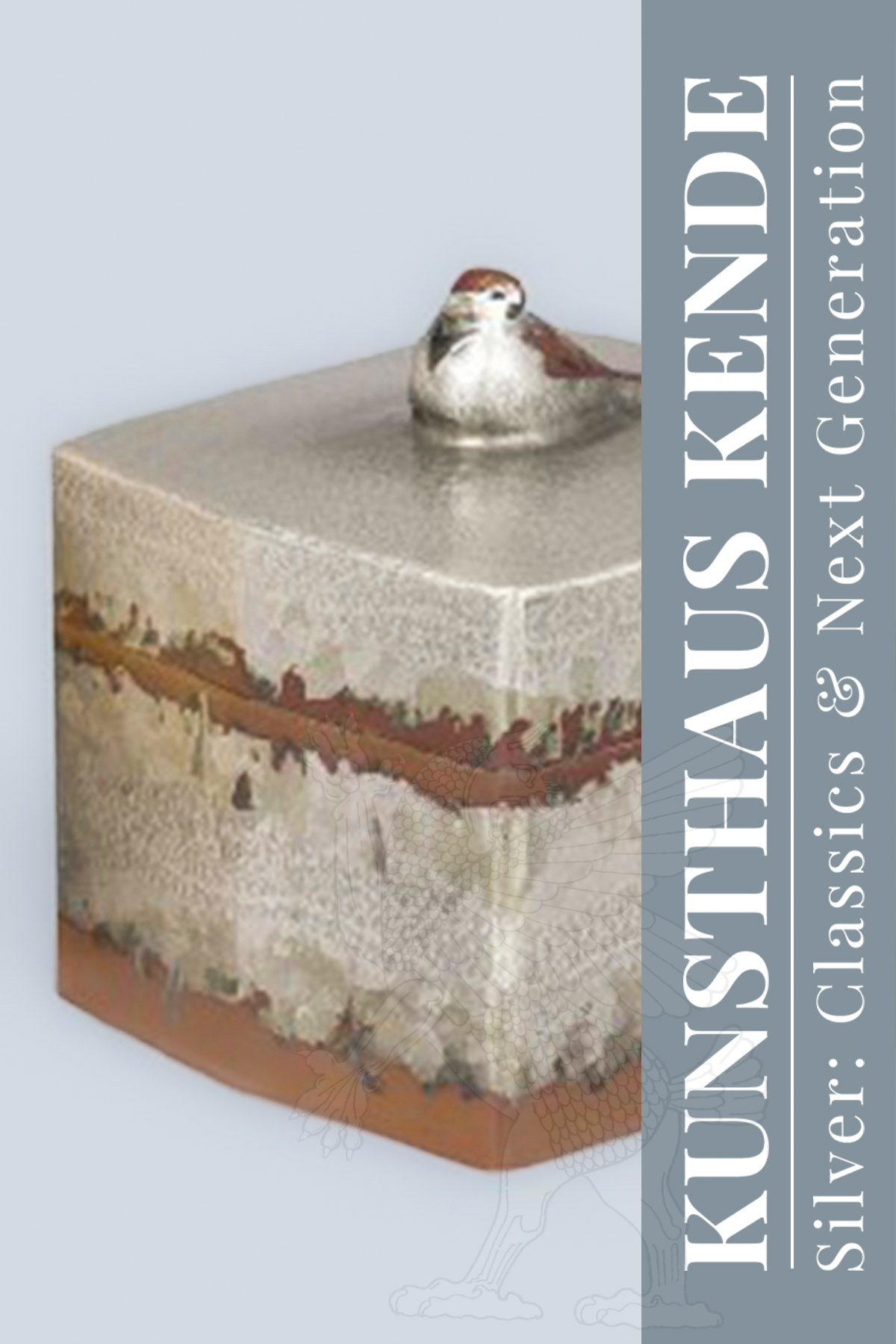
Of square shape, the front and back subtly widening towards the centre. The entire surface of the body is hammered and seamlessly transitions into the attached lid, which is crowned by a figure of a sparrow sitting fluffed up in the remaining snow of the fading winter as a knob. The interior is covered with embossed lacquered paper and stored in a traditional tomobako.
8.0 cm / 3.14″ length, 8.7 cm / 3.42″ width, 9.1 cm / 3.58″ tall
With its unpretentious and subtle elegance, this piece embodies a truly paradigmatic combination of the finest Japanese forging techniques. On the first view the forged depiction of a sparrow waiting for spring appears to be attached to the solid plate of the lid but it has been martellated out with a hammer from the thick sheet of silver. The brown plumage, which appears to be enamelled and runs from the head over the back to the tip of the tail, is hammered out of a thin copper plate, which was worked into a negative mould to fit the body of the sparrow and then soldered on. The depiction of the thawing snow surrounding the sparrow, under which the delicate tips of the grass are already faintly visible, was hammered out in an extremely laborious process using very thin chisels (in Japanese ‘Hatsuri’) and small hammers.
The side abstractly depicts nature gradually awakening beneath the melting snow, illustrated using a technique developed by the artist called ‘Kakuhanmon’. This technique allows different metals such as silver, copper, shakudo and shibuichi to be joined together. In the first step, the metals are welded together to form a solid block, which is then sawn into thin strips. In the next step, these strips are joined together with precision and connected by solder. This creates a continuous, swirling, highly dynamic pattern. The lively character is further enhanced by the wave-shaped friezes created in the metal using various hatsuri. The artist then decorated the pattern with small metal plates of different colours, which were inserted using the traditional Japanese technique kiribame-zogan.
This work was presented at the 50th East Japan Traditional Kogei Exhibition in Tokyo in 2010.
Japanese artist and silversmith Motoko Oshiyama
After graduating from Bunka Gakuen University in Shinjuku in 1981, Tokyo, Motoko Oshiyama (born 1957) refined her craftsmanship under Katsura Moriyuki (1914–1996) and Okuyama Hōseki (born 1935), who holds the title of Living National Treasure. Under the influence of her teachers, the artist specialised in metalwork in silver in combination with different metals. The artist prefers motifs from Japanese natural phenomena and landscapes, combined with depictions of the local flora and fauna. When choosing colours for her metalwork, she attaches particular importance to harmony and power. Her main technique, ‘Kakuhanmon’, consists of creating swirling patterns by fusing two or more metals. In addition, she uses a variety of different chasing and soldering techniques and explores further artistic possibilities through the combination of these techniques. Today, the artist teaches metalworking techniques at Bunka Gakuen University. Motoko Oshiyama is a permanent member of the Japan Kogei Association and the Yamanashi Art Association.
Awards (selection):
1996: Incentive Award at the 36th Exhibition of New Works of Traditional Art Crafts
2001: 18th Tansuiou Prize
2003: Japan Kogei Association Award at the 32nd Japanese Traditional Metalwork Exhibition
2010: 50th Anniversary Award at the 50th East Japan Traditional Kogei Exhibition (with the work presented here)
2014: Tokyo Board of Education Award at the 43rd Japanese Traditional Metalwork Exhibition
Public collections: A lidded box by the artist is in the Metropolitan Museum of Art, New York (see here). Works by Motoko Oshiyama are also in the National Museum of Asian Art at the Smithsonian Institution, Washington, and the Ise Cultural Foundation, New York.